
AID Systems Guide, Tandem Control-IQ
Tandem Control-IQ
Tandem’s Control-IQ is the most customisable of the mainstream AID systems, and now runs on two pumps, the tubed t:slim X2 and the miniature on-body Mobi. Its glucose target is fixed, so the work of getting the most out of it lives in the settings you and your care team programme: correction factor, insulin-to-carb ratio, and basal rates. It does not learn or adapt on its own, and in trained hands that makes it one of the most capable systems available.
Ask Grace
Want to talk through your own Control-IQ settings and profiles? Ask Grace.
Control-IQ at a glance
- Primary lever: Correction Factor (CF), the setting with the biggest real-world effect on time in range
- Age range: 2 years and older (Control-IQ+, via the 9 kg weight floor); 6 and older on legacy Control-IQ
- Time in range: 79.1% mean in the strongest correction-factor quartile (Messer et al. 2023, n=20,764 real-world); this is the top-quartile mean, not a whole-population mean
- Known for: most customisable settings, a fixed glucose target, predictive Autobolus
- CGM options: Dexcom G6 and G7 (all markets), FreeStyle Libre 2 Plus (US), FreeStyle Libre 3 Plus (added with Control-IQ+)
GNL thinks of Control-IQ as the Spider-Man of AID systems.

Control-IQ really allows the personalisation of the algorithm. But with great power, it’s the user and diabetes team’s responsibility to keep the basal rate up to date and the correction factor optimised. If this is looked after, Control-IQ really can get great results for anyone, true versatility.
System profile
What it looks like
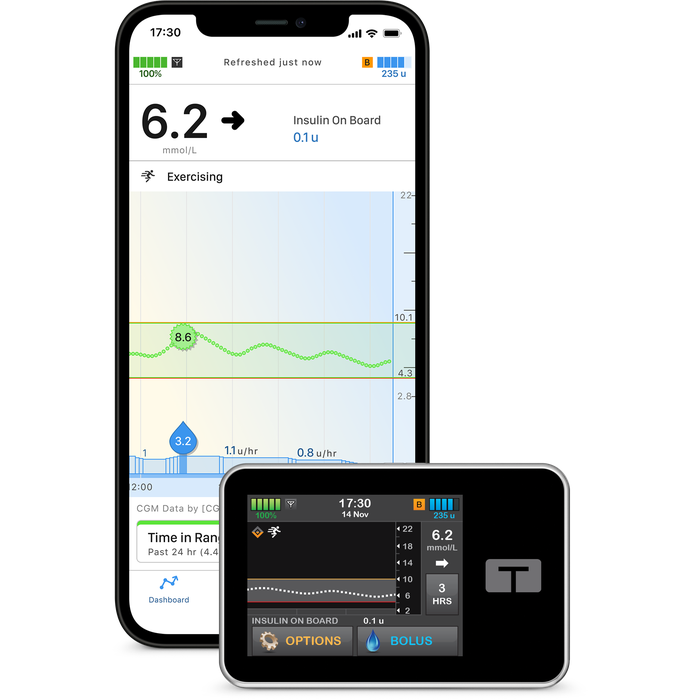
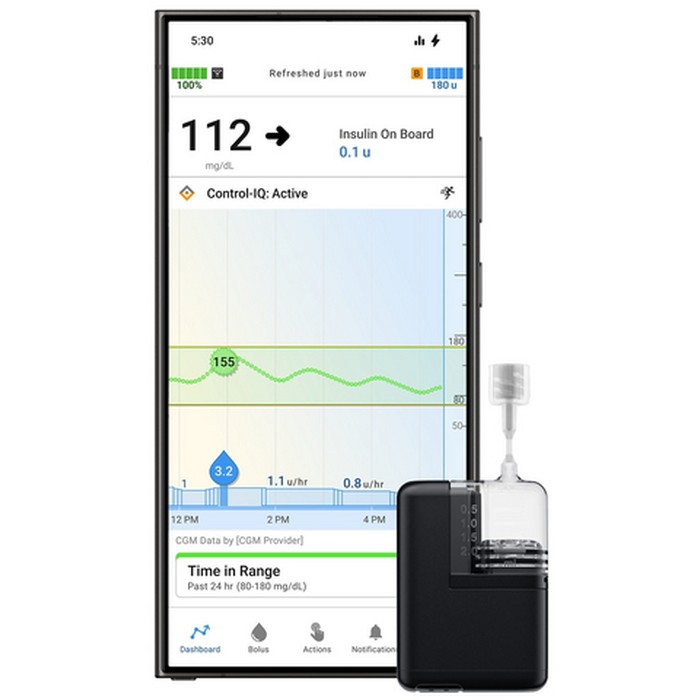
The reservoir sits inside the pump body; tubing runs to a cannula site.
The advancement. The t:slim X2 now ships with Control-IQ+ (CIQ+) as standard, the current-generation algorithm, rather than the legacy version. CIQ+ widens the weight and TDD ranges and raises the age indication down to 2 years and older. It also closes a gap between two different correction-factor caps: on legacy Control-IQ, a correction you enter yourself could already be programmed as gentle as 33 mmol/L (600 mg/dL) per unit, but the algorithm’s own automatic corrections, the Autobolus, were limited to a stronger minimum of 11 mmol/L (200 mg/dL) per unit, it could not be set any gentler than that. CIQ+ raises that algorithm-side cap to match, both now able to go as gentle as 33 mmol/L (600 mg/dL) per unit. The higher the correction-factor number, the weaker the correction it delivers, so this matters most for very insulin-sensitive people, a 2-year-old being the clearest example, where the old 11 mmol/L floor risked the Autobolus correcting harder than was safe.
The technical detail: unit allowances, legacy vs Control-IQ+
| Allowance | Legacy Control-IQ | Control-IQ+ |
|---|---|---|
| Weight range | 25 to 140 kg | 9 to 200 kg |
| Total daily dose (TDD) | 10 to 100 U/day | 5 to 200 U/day |
| CF cap, algorithm’s own Autobolus | 11 mmol/L (200 mg/dL) | 33 mmol/L (600 mg/dL) |
| CF cap, your own manual correction | 33 mmol/L (600 mg/dL) | 33 mmol/L (600 mg/dL), unchanged |
| Temp basal, automation ON | No, auto must be off | Yes, up to 72 hours |
| Extended bolus, automation ON | No, auto must be off | Yes, up to 8 hours |
Reading the CF cap rows: a higher correction-factor number is a gentler, weaker correction per unit, not a stronger one. On legacy Control-IQ, a manual correction could already be set as gentle as 33 mmol/L, but the Autobolus itself could never be set gentler than 11 mmol/L. CIQ+ raises that algorithm-side floor to match, so the Autobolus can now be programmed just as gently as a manual correction always could, which matters most for insulin-sensitive people, a 2-year-old being the clearest example.
Two pumps, one algorithm: t:slim X2 vs Mobi
Tandem Mobi runs Control-IQ+ only, the same current-generation algorithm as a CIQ+-equipped t:slim X2, on a miniature on-body pump. It is not tubeless in the Omnipod sense, a short 12 cm tube still connects the pump to the infusion site, but Mobi ships with adhesive sleeves that let you wear it directly on the body, patch-style, or carry it off-body, clipped to clothing or in a pocket, the same short tube either way. That on-body-or-off-body choice is a genuine advance over the t:slim X2, which is always carried separately. Everything in this guide about how Control-IQ+ behaves applies equally to Mobi; the difference is entirely in the hardware, not the settings. Photos of both pumps, each with the t:connect mobile app, are above.
System overview: t:slim X2 vs Mobi
| Field | t:slim X2 | Mobi |
|---|---|---|
| Form factor | Tethered (tubed), handheld pump | Miniature pump, short 12 cm tube, not tubeless |
| Wear options | Carried separately, clipped or pocketed | On-body via adhesive sleeve, or off-body clipped or pocketed, same tube either way |
| Reservoir | 300 units | 200 units, 30-unit minimum fill |
| Charging | Rechargeable, USB cable | Rechargeable, inductive (wireless) |
| Water resistance | IP27 | IP28, tested at 8 feet for 2 hours |
| Control | Pump touchscreen | Mobile app plus on-pump bolus button (US; UK app availability TBD) |
| CGM compatibility | Dexcom G6 and G7; FreeStyle Libre 3 Plus with CIQ+ (UK) | Dexcom G6 and G7 (FDA); FreeStyle Libre 3 Plus with CIQ+ (UK, subject to MHRA clearance) |
CGM interoperability
Control-IQ pairs with Dexcom G6 and G7 across all markets. Abbott FreeStyle Libre 2 Plus integration exists under FDA labelling in the US only, not available in Europe; Control-IQ+ adds FreeStyle Libre 3 Plus in the UK and upgrades the US Libre line. Regional availability varies, verify current market pairing before a market-specific claim.
| Sensor | Wear | Where it sits today |
|---|---|---|
| Dexcom G6 | 10 days | Established pairing, all markets |
| Dexcom G7 | 10 days (12h grace) | Established pairing, all markets |
| FreeStyle Libre 2 Plus | 15 days | US only |
| FreeStyle Libre 3 Plus | 15 days | Added with Control-IQ+ |
How it shares data
The t:slim X2 pairs to the t:connect mobile app on the wearer’s phone, mirroring glucose and pump data in real time. From there, data uploads to Tandem Source, Tandem’s cloud platform, where the diabetes care team reviews trends and reports between appointments. Followers can also view glucose data through SugarMate, a third-party app.
Age bands and regulatory status
| Region | Age indication | Notes |
|---|---|---|
| Control-IQ+ (CIQ+), now standard | 2 years and older | Enabled by the 9 kg weight floor. Licensed for pregnancy. |
| Legacy Control-IQ | 6 years and older | Applies only to pumps not yet upgraded to CIQ+ |
Licensed for pregnancy. Control-IQ, including Control-IQ+, is licensed for use in pregnancy, alongside MiniMed 780G and CamAPS FX. CIRCUIT (Donovan et al. 2025, JAMA 334:2176-2185), a randomised controlled trial, is the pivotal evidence: across 16 to 34 weeks’ gestation, closed-loop delivered around 3 hours per day more time in the pregnancy target range (3.5 to 7.8 mmol/L, 63 to 140 mg/dL) than standard care. A prespecified secondary analysis (Donovan et al. 2026, Diabetes Care 49:1-9) covered the intrapartum and early postpartum windows. Any settings change in pregnancy is a conversation with the diabetes-in-pregnancy team.
Control-IQ+ really adds value by allowing the algorithm to use a correction factor as relaxed as 1 unit : 33 mmol/L. This lets younger children and insulin-sensitive adults get the full benefit of Control-IQ. Mobi, with its on-body and off-body wear options, adds real flexibility, and there’s a good choice of infusion sets to go with it.
How the algorithm works
Unlike 780G, Control-IQ’s glucose target is fixed at 6.1 mmol/L (110 mg/dL) and cannot be changed. Every five minutes it adjusts basal insulin using your programmed Correction Factor (CF), and separately, its predictive Autobolus fires when it forecasts your glucose will exceed 10 mmol/L (180 mg/dL) in the next 30 minutes. Falling, or predicted to fall below 3.9 mmol/L: basal is trimmed or suspended. Rising, but not predicted to breach 10 mmol/L in 30 minutes: basal adjusts via CF, no Autobolus. Predicted to exceed 10 mmol/L within 30 minutes: the Autobolus fires on top of the basal adjustment, delivering around 60% of the insulin needed to bring you back to the 6.1 mmol/L target, at most once per hour. The Autobolus keeps running during Exercise Activity mode; it is switched off only in Sleep Activity. The algorithm does not learn or adapt on its own, it relies on the correction factor, insulin-to-carb ratio, and basal rates being set right by you and your care team.
Keeping the basal percentage at 50% or above in this ladder is about where the day’s insulin comes from, not about a fixed ceiling. Control-IQ counts bolus insulin, including its own Autobolus, towards insulin on board; insulin delivered at the programmed basal rate does not add to that figure. Tandem’s own User Guide describes the maximum automated delivery rate as a calculated value that depends on your correction factor, the total daily insulin Control-IQ estimates from your actual use, and your current IOB, so accumulated IOB is one of the things that restrains further automated delivery. A basal profile carrying a fair share of the day’s insulin leaves less to arrive as bolus, and less IOB to handcuff Control-IQ. Worth knowing: the widely repeated line that automated basal increases cap at four times the set rate is not something Tandem documents. The ceiling is calculated, not a multiple of your programmed rate.
Optimising Control-IQ: the five-level ladder
Control-IQ has no adjustable glucose target, so its ladder runs on three levers instead: Correction Factor first (the biggest real-world effect on time in range), basal percentage second (a calculation, not a setting to chase directly), and insulin-to-carb ratio third. Most people start at Level 3 and move up to Level 4, then Level 5, as quickly as tolerated.
| Level | CF rule (mmol/L) | Basal % (calculation) | ICR rule (g/U) |
|---|---|---|---|
| 5, Strongest | 80 / TDD | 65% | 300 / TDD |
| 4, Strong | 85 / TDD | 60% | 330 / TDD |
| 3, Balanced (default start) | 90 / TDD | 55% | 400 / TDD |
| 2, Gentle | 100 / TDD | 50% | 450 / TDD |
| 1, Protective | 110 / TDD | 45% | 500 / TDD |
This ladder is a GNL educational synthesis, Grade D, reviewed with input from the manufacturers’ medical leads but not endorsed; full detail in the Notes below. Any change to your correction factor, basal rate, or insulin-to-carb ratio is a conversation with your diabetes care team.
Registry data (Messer et al. 2023, n=20,764): the strongest CF quartile achieves 14% higher time in range than the weakest, the single most impactful setting to get right.
Correction factor, basal percentage, and insulin-to-carb ratio are exactly what the GNL AID Algorithm Optimiser Explorer walks through for this system (educational synthesis, not a device setting).
The stop condition. If time below 3.9 mmol/L rises above 4%, hold at the current level or step back one.
Sleep Activity is not part of this ladder. It is an additional consideration you layer on top at any level: run it 24 hours a day if you bolus for most meals, or at night only if daytime meal boluses are often missed, because Sleep Activity switches off the Autobolus while it is active.
Focus on getting basal to at least 50%, then push the correction factor as strong as possible without causing too many hypos.
Exercise: getting the most out of Exercise Activity mode
Turn on Exercise Activity mode 60 to 90 minutes before you start. This raises the target to 8.9 mmol/L (160 mg/dL), the highest exercise target among the AID systems GNL covers, and lifts the basal-suspend trigger from 3.9 to 4.4 mmol/L, giving more headroom before insulin delivery cuts out. The predictive Autobolus keeps running during Exercise Activity mode; it is switched off only in Sleep Activity, so don’t confuse the two.
Then take small carbohydrate top-ups every 20 minutes as needed, rather than one large amount upfront, a big carbohydrate load can spike glucose and prompt a stronger correction, raising hypo risk later in the session.
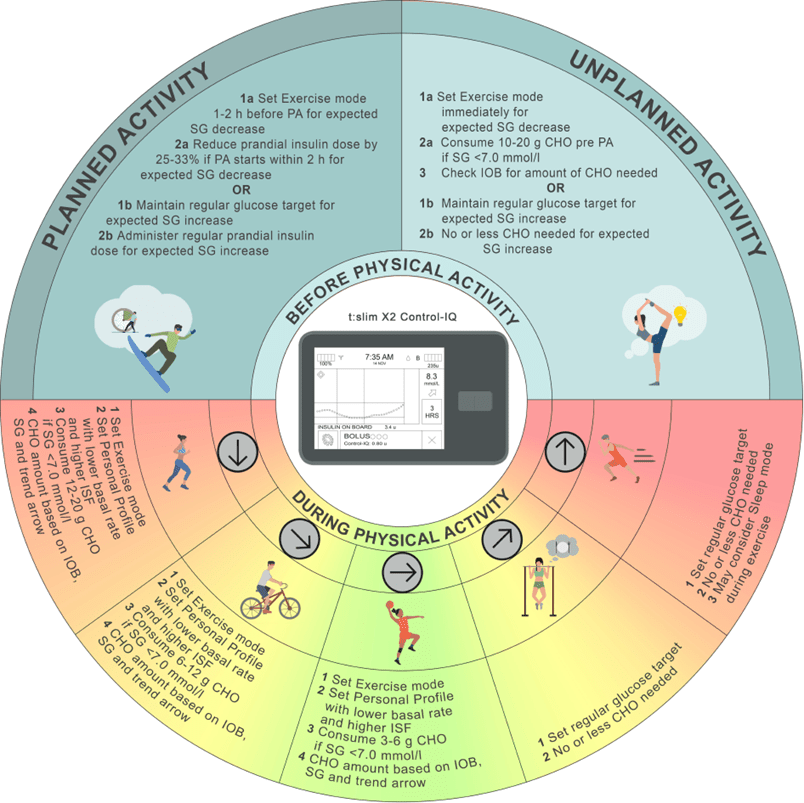
This is a live capture of GNL’s free Carbs for Thirty Minutes of Exercise Explorer, one of the tools on the Grace page. To find it: open theglucoseneverlies.com/gnl-grace, accept the one-off consent step, choose the Explorers tab, then Carbs for Thirty Minutes of Exercise. The snippet below shows the input side (top: 50 kg, 5.5 mmol/L falling slowly, aerobic exercise, AID/auto pump insulin therapy, a 7-unit bolus taken 90 minutes earlier) and the output it produced (bottom: insulin-on-board and the estimated carbohydrate range) for a 50 kg person. Enter your own weight and recent doses to get your own estimate.
Worth knowing before comparing this to your own pump: the IOB this Explorer estimates is physiological, based on how long insulin genuinely stays active in the body. Control-IQ displays its own device IOB, calculated from a fixed 5-hour insulin action time, which is not adjustable the way 780G’s Active Insulin Time is, so where you sit on the five-level ladder above does not change what your pump’s IOB figure means. The two numbers answer different questions: the Explorer’s physiological estimate of insulin still working, and the device’s fixed-duration model.
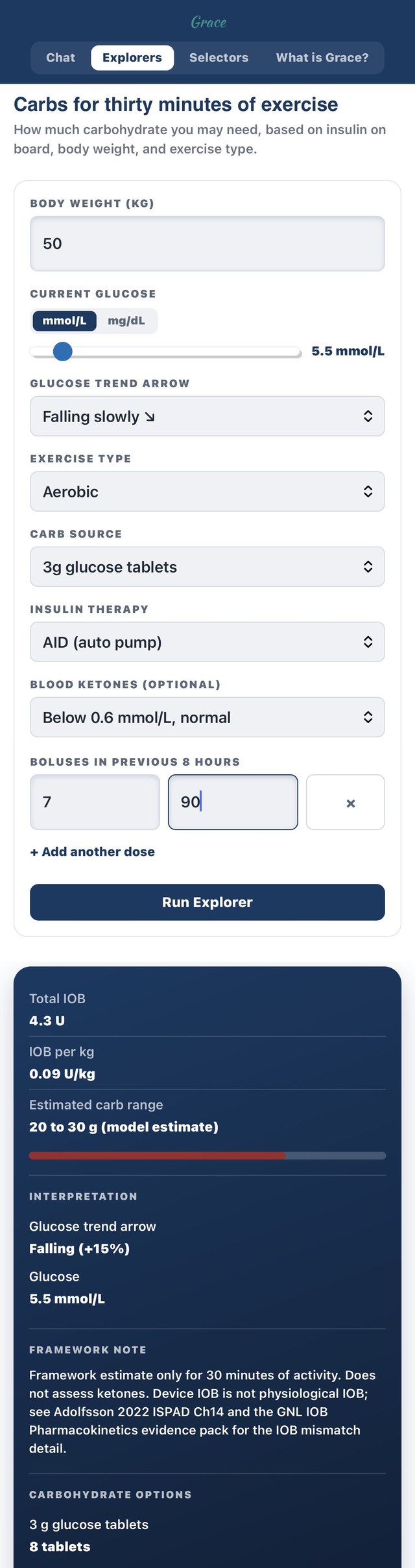
For planned, longer sessions, the T25/T25 framework below is written for AID systems specifically, the manual reductions are smaller than the injections/pump-only version because the algorithm is already doing some of the work.
The AID and Exercise Consensus Guideline (EASD/ISPAD 2025, Moser, Zaharieva, Pemberton et al.) is worth reading alongside this.
The technical detail: what Exercise Activity mode actually changes
Exercise Activity mode does not just raise a number on the screen. While active, Control-IQ corrects towards 8.9 mmol/L instead of the fixed 6.1 mmol/L target, and the basal-suspend trigger lifts from 3.9 to 4.4 mmol/L, so basal cuts out sooner as glucose falls. This is why the 60 to 90 minute lead time matters, it needs time to actually reduce insulin on board before activity starts.
Meals: high-fat and high-protein
High-fat meals
Pizza, takeaways, anything high in fat alongside the carbohydrate, tend to need a different approach because fat delays how quickly the meal actually raises your glucose. Because Control-IQ’s target is fixed and its Autobolus is threshold-triggered rather than continuously adjusting, a common starting point is entering all the carbohydrate upfront using your normal ICR and letting the predictive Autobolus catch a delayed rise if it crosses 10 mmol/L in the 30-minute forecast. Control-IQ+ gives another option here: because it allows an extended bolus of up to 8 hours while automation stays on (not possible on legacy Control-IQ, where automation has to be switched off first), splitting a dose over time is a genuine alternative for pizza, pasta, and other high-fat, high-carb meals, spreading delivery to match the slower rise instead of relying on the Autobolus to catch up later. A common starting split is roughly 50% of the dose upfront and 50% extended, with the total dose increased by around 25% to cover the fat load, extended over several hours up to the 8-hour maximum on Control-IQ+, population-average starting points to explore with your care team, not a fixed prescription.
Adjusting from experience. If a delayed rise still shows up: entering extra carbohydrate (“fake carbs”), typically 25 to 50% of the original amount, around 90 minutes after eating is a common adjustment. If glucose runs low in the first 2 to 3 hours instead: entering around 75% of the carbohydrate upfront is a common alternative. These are population-average starting points for exploration, not a personal prescription.
High-protein meals
Protein on its own behaves differently from fat: it raises glucose more slowly and more gently, and does not need the same split-dose approach. A single bolus, delivered upfront using your normal ICR, is the usual starting point, roughly 15 to 20% extra on top of your normal dose for the meal.
Combining high fat and high protein in the same meal (a steak dinner, a protein-heavy curry) tends to need the biggest adjustment of the three, commonly around 50% extra in total, split the same way as a high-fat meal.
The technical detail: why delayed absorption confuses a fixed-target, threshold-triggered algorithm
Control-IQ’s Autobolus only fires once its 30-minute forecast crosses 10 mmol/L, and at most once per hour. A high-fat or high-protein meal spreads its glucose effect out, so the forecast may not cross that threshold early, or it may cross it later than a typical carbohydrate-only meal would, meaning the automatic correction arrives later than you’d expect. Entering carbohydrate in two steps, or adjusting ICR, is a way of telling the algorithm what a typical meal-only bolus cannot.
An extended bolus might work, but if the meal is really high in fat and protein, you’ll likely need an extra 25 to 50% added to the carbs and spread out, since high insulin on board limits how effective the algorithm can be.
Hypo management
The algorithm prevents many overnight hypos by trimming or suspending basal as glucose falls or is predicted to fall below 3.9 mmol/L, but lows still happen, especially with unplanned exercise or a bolus that turns out too strong for the situation. Treatment amounts often need to be smaller than before AID, because Control-IQ has usually already reduced or suspended basal earlier than you’d expect. Worth treating pre-emptively if glucose is 4.0 to 6.0 mmol/L (70 to 110 mg/dL) and trending down, rather than waiting for a lower reading to confirm it.
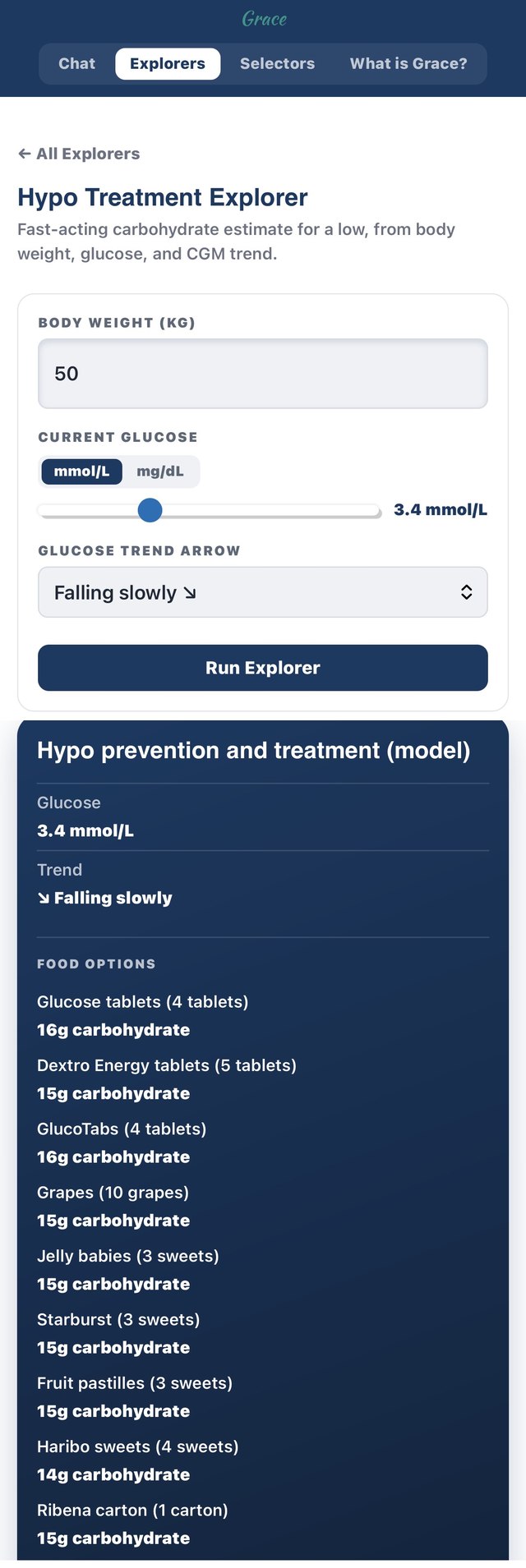
This is a live capture of GNL’s free Hypo Treatment Explorer, another of the tools on the Grace page. To find it: open theglucoseneverlies.com/gnl-grace, accept the one-off consent step, choose the Explorers tab, then Hypo Treatment Explorer. The snippet below shows the input side (top: 50 kg, 3.4 mmol/L, falling slowly) and the output it produced (bottom: a fast-acting carbohydrate estimate with everyday food options). Enter your own weight, glucose, and trend for your own estimate.
The technical detail: why treatment amounts shrink on AID
Pre-AID hypo treatment amounts are usually sized assuming insulin delivery continues unchanged until you intervene. Control-IQ has typically already been trimming or suspending basal for a while before you notice the low, so there is less insulin working against the treatment than a pre-AID rule of thumb assumes. The same weight-based amount that was right before AID commonly overshoots afterwards.
If you’re getting a lot of hypos after treating highs, relax the correction factor.
Hyper management
Control-IQ’s predictive Autobolus catches a lot of highs before they need anything else, but a high with rising ketones is a different situation, one the algorithm does not manage on its own. The Autobolus keeps delivering against the fixed 6.1 mmol/L target, and at most once an hour; it does not check for ketones and does not know if an infusion set has failed. A rising glucose that the Autobolus is not bringing down, especially alongside nausea or abdominal pain, needs the same ketone check and sick-day pathway as it would on any other therapy.
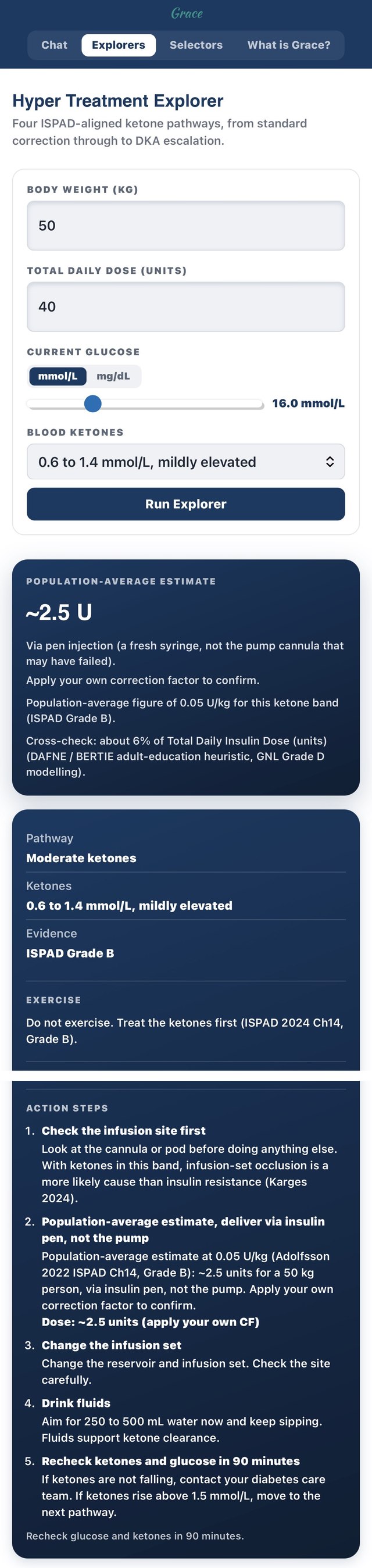
This is a live capture of GNL’s free Hyper Treatment Explorer, another of the tools on the Grace page. To find it: open theglucoseneverlies.com/gnl-grace, accept the one-off consent step, choose the Explorers tab, then Hyper Treatment Explorer. The snippet below shows the input side and the output it produced. Enter your own weight, TDD, glucose, and ketone reading, and select your own system under Therapy or AID, for your own estimate.
The technical detail: why the Autobolus is not a ketone response
The predictive Autobolus is a bolus response to a forecast glucose number and a fixed target, nothing more. It has no ketone input, so it cannot distinguish an ordinary high from one driven by insufficient insulin delivery, a failed cannula, or illness, the situations where ketones actually matter. A site that has stopped delivering insulin can sit alongside a rising glucose trace that looks, on the screen, like any other high the Autobolus is working on, and because the Autobolus is capped at once per hour it cannot correct a delivery failure the way a manual injection can.
A glucose stuck above 15.0 mmol/L (270 mg/dL) for a couple of hours, with no missed-bolus explanation, usually points to a delivery problem rather than a high that just needs a correction, so it is worth checking the cannula.
Under-5s
Control-IQ+ (CIQ+) is indicated from 2 years and older, enabled by a 9 kg weight floor. There is no Control-IQ trial dedicated to this age band the way LENNY sits behind the 780G’s age-2 approval; the expansion rests on the CIQ+ labelling change and the wider weight and dose ranges it brings, and the preschool AID evidence base as a whole is still thin relative to the older paediatric bands.
Children under six show a distinct diurnal insulin-need pattern: a clear evening rise in insulin need, roughly 17:00 to 22:00, followed by an overnight fall (Biester et al. 2023, DPV registry, n=25,718). On Control-IQ, the lever families use with their diabetes team is windowing Sleep Activity to the overnight phase rather than the evening rise, a gentler correction factor through that window keeps the algorithm from over-correcting once resistance drops, the same dusk-then-dawn pattern that shapes preschool settings on every AID system, not just this one. This is a clinic conversation, not a parental adjustment.
Preschoolers commonly need a stronger insulin-to-carb ratio than the standard ladder suggests: ISPAD 2024 Chapter 23 advises the 330 or 250 rule rather than 500 for this age band, and breakfast ICR often needs to be tighter still, around 150 / TDD, reflecting the dawn-phenomenon insulin resistance seen in young children. These are population-average starting points, the actual ratio for an individual child depends on weight and total daily dose as well as age band, so treat them as a starting point for the conversation with your diabetes team, not a number to apply directly. The related midday hypo trap and the equivalent tactics for other systems are covered in Type 1 in infants and preschoolers.
The trade-off to hold. Control-IQ’s glucose target is fixed at 6.1 mmol/L and cannot be softened for a very young child the way an adjustable-target system can. Preschool management leans instead on a gentler correction factor and on windowing Sleep Activity, both care-team decisions, not settings to push on your own. A parent watching for tighter numbers should read a slightly higher run as the system protecting against a hypo a young child often cannot communicate or self-treat.
Control-IQ works really well for under-5s. It’s possible to set a lower basal rate and a weaker correction factor between 11am and 3pm, then a stronger basal and correction factor from 6pm to 10pm, backing off again overnight, matching the circadian rhythm of a young child.
Listen: Mastering Control-IQ
Want to listen to the podcast? Episode 2: Mastering Control-IQ, The Spider-Man of AID explores how the Autobolus works, how to optimise settings, and how to manage exercise, high-fat meals, and hypo prevention.
For the wider picture across all four systems: Episode 6: Ten Tips to Optimise Time in Range, paired with the Top 10 Tips to Optimise Time in Range: AID Systems page.
New: for the Control-IQ+ update, the wider dose range, the sick day tool and the extended bolus, listen to Episode 43: Tandem Control-IQ+ and Mobi, with Laurel Messer.
Three great podcast episodes to get up to date with the best information on this.
Notes
Regulatory detail, evidence depth, and framing caveats behind this page
- GNL Insights. The GNL Insights boxes through this guide are the team’s own perspective and clinic experience: opinion and pattern-recognition, not a stated clinical fact or a personalised recommendation, distinct from the sourced claims and citations elsewhere on this page.
- Not a Tandem-endorsed configuration (Optimising Control-IQ: the five-level ladder). The five-level ladder is a GNL educational synthesis, graded D on a Grade A and B evidence base. The ladder, and the settings adjusted at each level, were reviewed and refined with input from the CamAPS, MiniMed, Tandem and Insulet global medical leads; that input shaped which levers are exposed and how they are described, but the levels are not validated against any manufacturer’s simulator or proprietary data, so this is not a manufacturer endorsement. Any settings change is a conversation with your diabetes care team.
- Pregnancy (System profile). Control-IQ and Control-IQ+ are licensed for use in pregnancy, alongside CamAPS FX and MiniMed 780G. The CIRCUIT trial (Donovan 2025, JAMA; Donovan 2026, Diabetes Care) is the evidence base; the gestation-window and intrapartum figures are two distinct results from two papers and should not be conflated.
- Population-average framing (Meals). The high-fat and high-protein starting points above are population-average (Pemberton 2021 matrix; Bell 2014/2015/2016/2020; Pankowska 2009/2012). Individual responses vary, and any change is a conversation with your diabetes care team.
Control-IQ Knowledge Check
You have read the practical guidance for Tandem's t:slim X2 with Control-IQ. A short assessment on it follows, and 9 out of 10 earns your certificate.
References
Key papers behind this page. Tap to expand.
Real-world outcomes and settings
- Breton MD, Kanapka LG, Beck RW et al. (2020). A randomized trial of closed-loop control in children with type 1 diabetes. NEJM. 383:836-845.
- Messer LH et al. (2023). Real-world Control-IQ outcomes. Diabetes Technology and Therapeutics. 25(9):617-625. n=20,764.
- Shah VN et al. (2026). Diabetes Obesity and Metabolism.
Head-to-head and safety
- Beato-Vibora PI et al. (2024). Control-IQ vs 780G, no significant TIR difference. Diabetes Care. n=150. DOI: 10.2337/dc23-1355.
- Gera V et al. (2025). Control-IQ vs Omnipod 5 in youth, no clinically significant TIR difference. n=428.
Pregnancy and postpartum (CIRCUIT)
- Donovan LE et al. (2025). CIRCUIT, gestation window. JAMA. 334:2176-2185.
- Donovan LE et al. (2026). CIRCUIT, intrapartum and postpartum. Diabetes Care. 49:1-9. DOI: 10.2337/dc26-0470.
Paediatric and meal-timing evidence
- ISPAD 2024 Chapter 23. Paediatric insulin-to-carb ratio guidance.
- Biester T et al. (2023). DPV registry, under-6 diurnal insulin-need pattern. Diabetes Technology and Therapeutics. n=25,718.
- Pemberton (2021 matrix). High-fat and high-protein dosing synthesis, GNL internal.
Manufacturer documentation
- Tandem Diabetes Care. t:slim X2 Insulin Pump with Control-IQ Technology User Guide. Ch.29, Introduction to Control-IQ Technology; Ch.30, Configuring and Using Control-IQ Technology. Source for the maximum automated delivery rate being a calculated value dependent on correction factor, estimated Total Daily Insulin and current insulin on board.
- Tandem Diabetes Care and ADCES. PantherTool for t:slim X2 and Mobi, Control-IQ clinician quick-reference, v.11.2025. Source for weight and Total Daily Insulin being the settings that determine maximum and minimum insulin delivery constraints.
Tandem Control-IQ
Tandem Source and mobile bolus, setup guide
A downloadable walkthrough for setting up Tandem Source and delivering a bolus from your phone with the t:slim X2, from account setup to your first mobile bolus.