
AID Systems Guide, MiniMed 780G
MiniMed 780G
The MiniMed 780G has SmartGuard, one of the simplest algorithms to operate and adjust. The partnership with Abbott to develop the Instinct sensor, alongside its own 7-day infusion set, means wearability can be maximised.
Ask Grace
Want to explore your 780G targets, active insulin time, or auto corrections? Ask Grace.
780G at a glance
- Primary strength lever: Active Insulin Time (AIT); target is the user-facing dial, adjustable from 5.5 mmol/L (100 mg/dL, the lowest setting) up to 6.7 mmol/L (120 mg/dL)
- Age range: 2 years and older (UK/EU); 7 and older (US, T1D)
- Time in range: 72.3% population mean; 78.8% mean on the optimal-settings configuration, target 100 mg/dL (5.5 mmol/L) and AIT 2 hours (Choudhary et al. 2024, n=101,629 real-world)
- Known for: simplicity, five-minute auto-corrections, strong overnight control
- CGM options: three MiniMed-ecosystem sensors (Guardian 4, Simplera Sync, Instinct), no Dexcom or consumer Libre
GNL thinks of the 780G as the Incredible Hulk of AID systems.

If Active Insulin Time is set short and the target glucose level is low, it is very effective at tackling after-meal high glucose levels, thanks to five-minute auto-corrections as required.
System profile
What it looks like
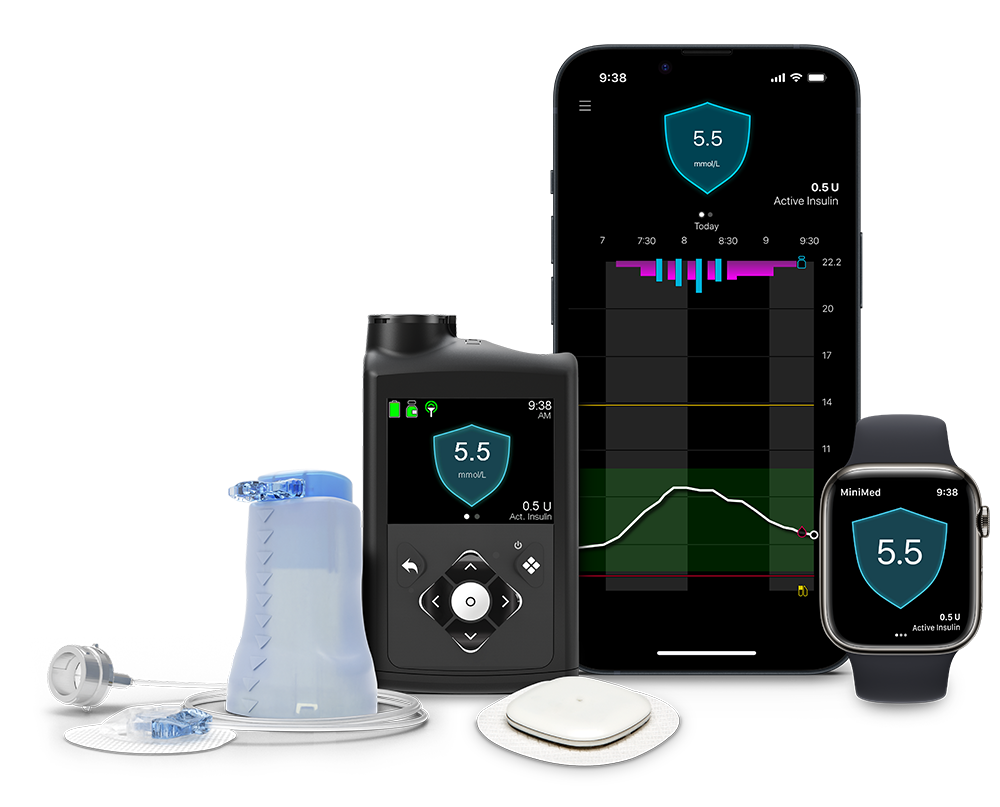

The reservoir sits inside the pump body; tubing runs to a cannula site.
CGM interoperability
The 780G pairs with three MiniMed-ecosystem sensors, and only these three. No Dexcom, no consumer FreeStyle Libre, at any point.
| Sensor | Wear | Where it sits today |
|---|---|---|
| Guardian Sensor 4 | 7 days | Current most-used installed base, most people on the system are wearing this one today |
| MiniMed Simplera Sync | 7 days (6 days plus 24h grace) | Forward-path pair, MiniMed’s growth product from 2026 |
| Instinct (Abbott-made for MiniMed) | Up to 15 days | Forward-path pair, the longer-wear option |
Never interchangeable with Abbott’s consumer FreeStyle Libre. The Instinct sensor shares hardware with FreeStyle Libre 3 Plus, but it is a separate, MiniMed-exclusive product: different app, different ecosystem, not available over the counter. Regional availability varies.
How it shares data
The 780G pump pairs over Bluetooth, up to 20 feet (6 metres), to the MiniMed Mobile app on the wearer’s phone, mirroring glucose and pump data in real time. From there, data uploads to the CareLink cloud server, MiniMed’s data platform. Followers, family, carers, the diabetes care team, view that data through a separate app, CareLink Connect, not the MiniMed Mobile app itself, up to five followers at a time.
| Step | What it is |
|---|---|
| 780G pump | Generates the glucose and dosing data |
| MiniMed Mobile app | Phone companion, paired over Bluetooth, wearer’s own view |
| CareLink server | MiniMed’s cloud platform, receives the upload |
| CareLink Connect app | Followers’ view, up to 5 followers, separate app from MiniMed Mobile |
Age bands and regulatory status
| Region | Age indication | Notes |
|---|---|---|
| UK / EU (CE) | 2 years and older | Type 1 AND insulin-requiring Type 2 (TDD 6 U/day or more). Also CE marked for pregnancy. |
| US (FDA) | 7 years and older (T1D); 18 and older (T2D) | Not approved for pregnancy in the US. Paediatric trials underway for ages 2 to 6. |
Licensed for pregnancy. The MiniMed 780G is CE marked for use in pregnancy, alongside Control-IQ and CamAPS FX. CRISTAL (Benhalima et al. 2024, Lancet Diabetes & Endocrinology 12(6):390-403), a randomised controlled trial, is the pivotal evidence behind this: advanced hybrid closed-loop improved time in pregnancy range without increasing hypoglycaemia. Not currently licensed for pregnancy in the US.
In Europe, the 780G has a broad range of indications, and bringing the Instinct sensor on board really changes the game: the longer wear and improved accuracy make a huge difference.
How the algorithm works
SmartGuard checks your glucose every five minutes and moves basal insulin in one of three directions. Falling, or predicted to go low: basal is trimmed, and can be cut to zero. Steady and in range: basal holds, not at your originally-programmed rate, but at SmartGuard’s own calculated rate, continuously updated from your insulin use over the past 2 to 6 days (after an initial 48-hour learning period in manual mode). Rising: basal increases first, in small steps, still working within that calculated basal pattern. Auto-correction is the extra step on top of that: it fires when SmartGuard’s own short-term prediction shows glucose still exceeding 6.7 mmol/L (120 mg/dL) and basal delivery is already at its maximum, reassessed roughly every 5 minutes while that condition holds. The one setting that changes how hard it works is Active Insulin Time (AIT): shorter AIT tells the algorithm insulin clears faster, so it acts sooner and more often. Carb ratio and correction factor are not part of any of this: SmartGuard never touches them, they stay exactly as you and your diabetes care team have programmed them.
The five-minute auto-corrections make SmartGuard very effective at getting on top of after-meal highs. But be aware: if Active Insulin Time is set to 2 hours, the displayed insulin-on-board will be underrepresented. So if you’re planning exercise, ask yourself whether you’ve given a bolus in the last three hours. If the answer is yes, hypo risk is still high, despite a 0-unit IOB reading.
Optimising 780G: the five-level ladder
Every setting on this ladder sits within the 780G’s normal adjustable range. MiniMed’s own recommended starting configuration sits at Level 5; the levels below de-rate from there.
| Level | AIT | Adult target | Paediatric floor (7 to 14) | Preschool floor (2 to 6) |
|---|---|---|---|---|
| 5, Strongest | 2 hours | 5.5 mmol/L | 6.1 mmol/L | 6.7 mmol/L |
| 4, Strong | 2.5 hours | 5.5 mmol/L | 6.1 mmol/L | 6.7 mmol/L |
| 3, Neutral | 3 hours | 5.5 mmol/L | 6.1 mmol/L | 6.7 mmol/L |
| 2, Weak | 3.5 hours | 6.1 mmol/L | 6.1 mmol/L | 6.7 mmol/L |
| 1, Weakest | 4 hours | 6.7 mmol/L | 6.7 mmol/L | 6.7 mmol/L |
Level 5 is MiniMed’s own recommended starting point (Bassi 2025, n=91 youth and young adults moving to it: +3.1 percentage points time in range, no rise in hypoglycaemia). The age-banded floors on the right are MiniMed Medical Affairs values, not GNL synthesis, they exist specifically to cap hypo risk in younger and older users. Older adults (65+) get the same 6.1 mmol/L floor as the paediatric band from Level 2 up, easing to 6.7 mmol/L at Level 1, for the same reason.
This ladder is a GNL educational synthesis, Grade D, reviewed with input from the manufacturers’ medical leads but not endorsed; full detail in the Notes below. Any change to your Active Insulin Time or glucose target is a conversation with your diabetes care team.
To see how a chosen algorithm-strength tier translates into a basal:bolus split, and from there into carb ratio, the GNL AID Algorithm Optimiser Explorer covers that ground in detail (educational synthesis, not a device setting).
The stop condition. If time below 3.9 mmol/L rises above 4%, hold at the current level or step back one. This applies at every level, not just the top of the ladder.
It’s simple: the shorter the Active Insulin Time and the lower the target, the stronger SmartGuard can be. Find the right balance. If you’re fighting hypos all the time, you can scale down the ladder as needed.
Exercise: getting the most out of Temp Target
Turn on Temp Target 60 to 90 minutes before you start. This is a separate control from your day-to-day glucose target: it temporarily raises the target to 8.3 mmol/L (150 mg/dL) and reduces insulin delivery, giving insulin-on-board time to fall before you begin. It is not one of the three regular targets (5.5, 6.1, 6.7), and it does not replace them permanently.
Then take small carbohydrate top-ups every 20 minutes as needed, rather than one large amount upfront, a big carbohydrate load can spike glucose and prompt the algorithm to increase insulin, raising hypo risk later in the session.
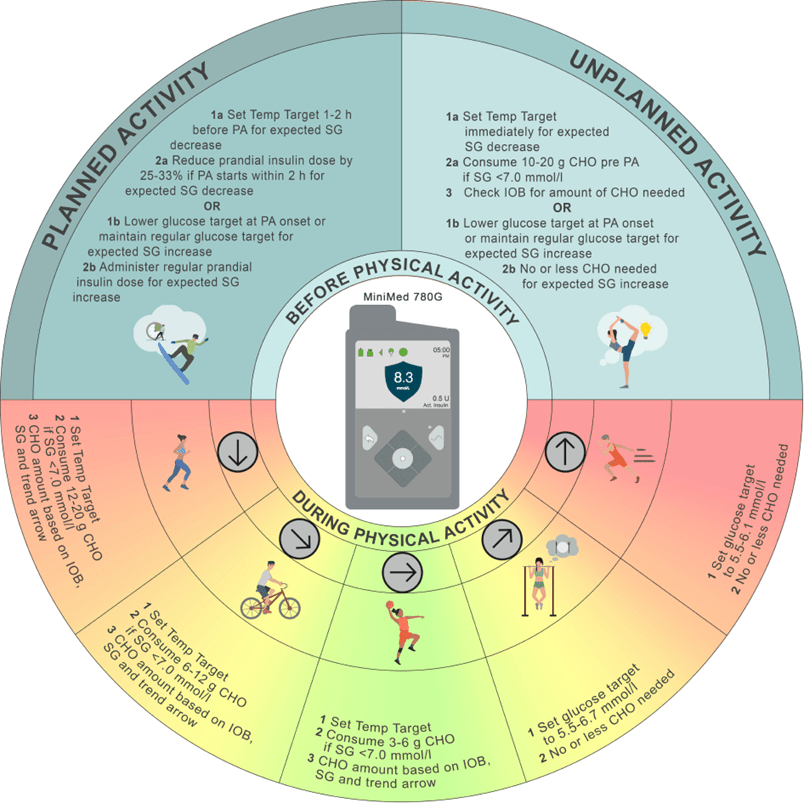
This is a live capture of GNL’s free Carbs for Thirty Minutes of Exercise Explorer, one of the tools on the Grace page. To find it: open theglucoseneverlies.com/gnl-grace, accept the one-off consent step, choose the Explorers tab, then Carbs for Thirty Minutes of Exercise. The snippet below shows the input side (top: 50 kg, 5.5 mmol/L falling slowly, aerobic exercise, AID/auto pump insulin therapy, a 7-unit bolus taken 90 minutes earlier) and the output it produced (bottom: insulin-on-board and the estimated carbohydrate range) for a 50 kg person. Enter your own weight and recent doses to get your own estimate.
Worth knowing before comparing this to your own pump: the IOB this Explorer estimates is physiological, based on how long insulin genuinely stays active in the body, not the device IOB your pump displays. Your pump’s own figure is driven by AIT, which is set by where you sit on the five-level ladder above. The shorter the AIT (Levels 4 and 5), the more your pump’s displayed IOB will underestimate what this Explorer shows, the exact mismatch flagged earlier in How the algorithm works.
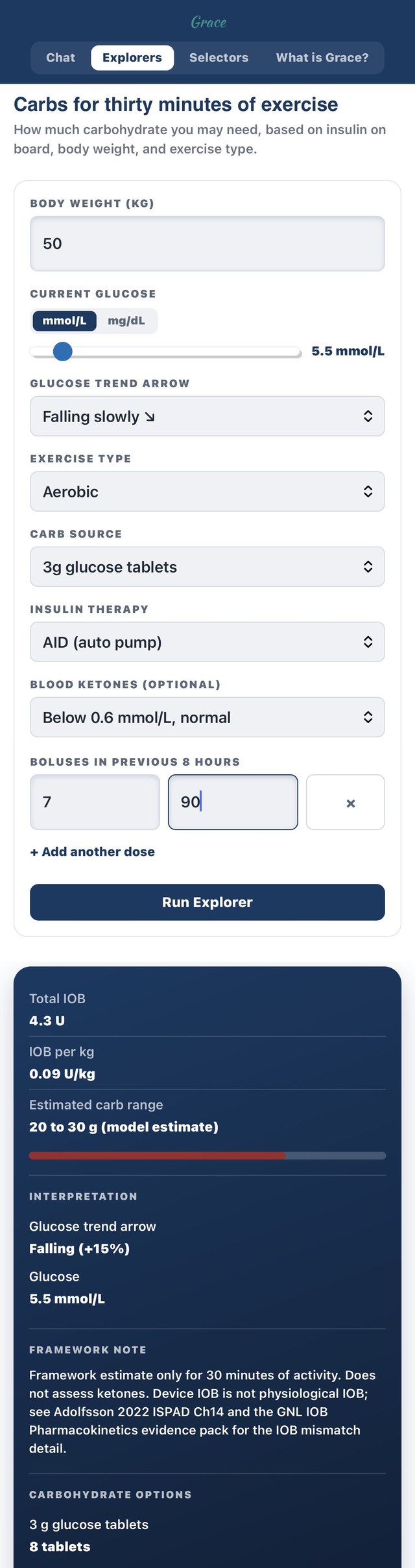
For planned, longer sessions, the T25/T25 framework below is written for AID systems specifically, the manual reductions are smaller than the injections/pump-only version because the algorithm is already doing some of the work.
The AID and Exercise Consensus Guideline (EASD/ISPAD 2025, Moser, Zaharieva, Pemberton et al.) is worth reading alongside this.
The technical detail: what Temp Target actually changes
Temp Target does not just raise a number on the screen. While active, SmartGuard treats 8.3 mmol/L as the level it is correcting towards instead of your usual 5.5, 6.1, or 6.7 mmol/L target, so it delivers less basal and holds off on auto-corrections earlier than it otherwise would. This is why the 60 to 90 minute lead time matters, it needs time to actually reduce insulin on board before activity starts, not just at the moment you begin.
As mentioned earlier, if Active Insulin Time is set to 2 hours, IOB won’t tell you your hypo risk. So think about whether a meal bolus has been given in the last 3 hours, or try the Carbs for Thirty Minutes of Exercise Explorer.
Meals: high-fat and high-protein
High-fat meals
Pizza, takeaways, anything high in fat alongside the carbohydrate, tend to need a different approach because fat delays how quickly the meal actually raises your glucose. A common starting point: enter all the carbohydrate upfront and let SmartGuard respond to the delayed rise, at an AIT of 2 to 3 hours it generally handles this reasonably well.
Adjusting from experience. If a delayed rise still shows up: entering extra carbohydrate (“fake carbs”), typically 25 to 50% of the original amount, around 90 minutes after eating is a common adjustment. If glucose runs low in the first 2 to 3 hours instead: entering around 75% of the carbohydrate upfront is a common alternative. These are population-average starting points for exploration, not a personal prescription.
High-protein meals
Protein on its own behaves differently from fat: it raises glucose more slowly and more gently, and does not need the same split-dose approach. A single bolus, delivered upfront, is the usual starting point, roughly 15 to 20% extra on top of your normal dose for the meal, not a second delayed dose the way a high-fat meal often needs.
Combining high fat and high protein in the same meal (a steak dinner, a protein-heavy curry) tends to need the biggest adjustment of the three, commonly around 50% extra in total, split the same way as a high-fat meal.
The technical detail: why delayed absorption confuses a fixed-target algorithm
SmartGuard is reacting to what your CGM shows right now, not to what a meal is going to do over the next three hours. A high-fat or high-protein meal spreads its glucose effect out, so the algorithm sees a slower, later rise than a typical carbohydrate-only meal, and may correct later than you would expect, or under-correct in the first hour and then have to catch up in the second and third. Entering carbohydrate in two steps, or adjusting the ratio, is a way of telling the algorithm what a typical meal-only bolus cannot.
SmartGuard is very effective at stopping delayed highs if Active Insulin Time is 2 hours, but if the meal is really high in fat and protein, some fake carbs 90 minutes after eating can help prevent long, delayed highs.
Hypo management
The algorithm prevents many overnight hypos, but they still happen, especially with unplanned exercise or a bolus that turns out too strong for the situation. Treatment amounts often need to be smaller than before AID, because SmartGuard has usually already reduced or stopped insulin at least 30 minutes earlier than you’d expect. Worth treating pre-emptively if glucose is 4.0 to 6.0 mmol/L (70 to 110 mg/dL) and trending down, rather than waiting for a lower reading to confirm it.
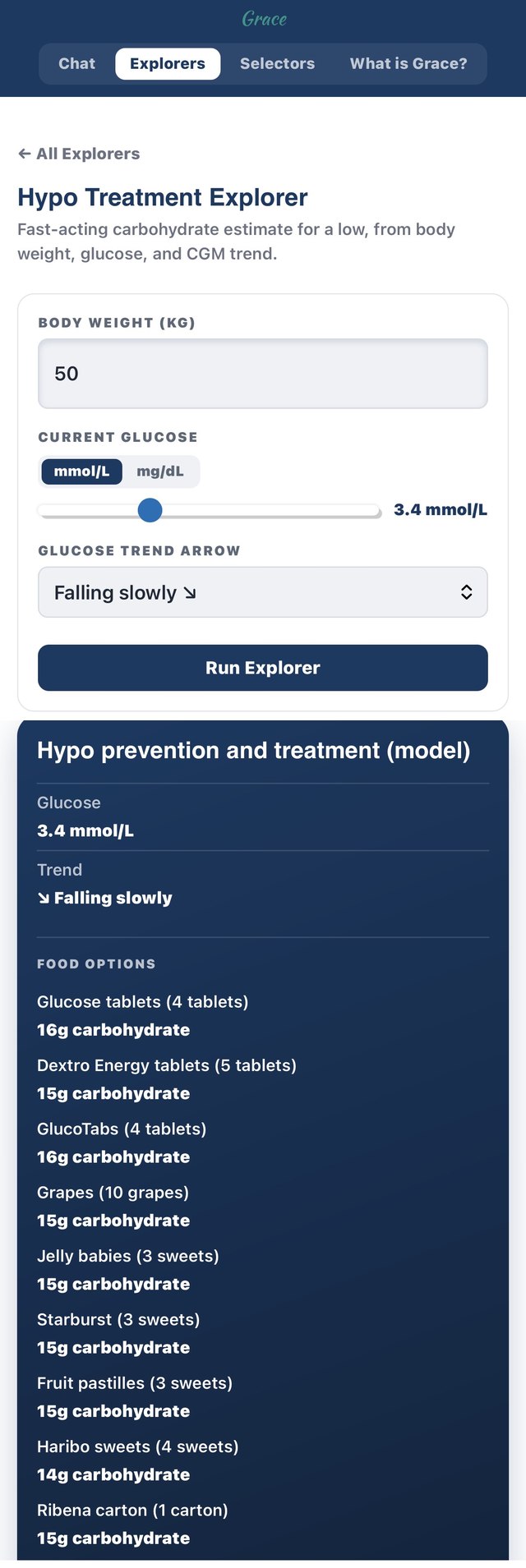
This is a live capture of GNL’s free Hypo Treatment Explorer, another of the tools on the Grace page. To find it: open theglucoseneverlies.com/gnl-grace, accept the one-off consent step, choose the Explorers tab, then Hypo Treatment Explorer. The snippet below shows the input side (top: 50 kg, 3.4 mmol/L, falling slowly) and the output it produced (bottom: a fast-acting carbohydrate estimate with everyday food options). Enter your own weight, glucose, and trend for your own estimate.
The technical detail: why treatment amounts shrink on AID
Pre-AID hypo treatment amounts are usually sized assuming insulin delivery continues unchanged until you intervene. SmartGuard has typically already been trimming or suspending basal for a while before you notice the low, so there is less insulin working against the treatment than a pre-AID rule of thumb assumes. The same weight-based amount that was right before AID commonly overshoots afterwards.
If you’re battling hypos all the time, consider coming down the setting ladder. Or it may be that you need to use Temp Target for times of the day with high insulin sensitivity.
Hyper management
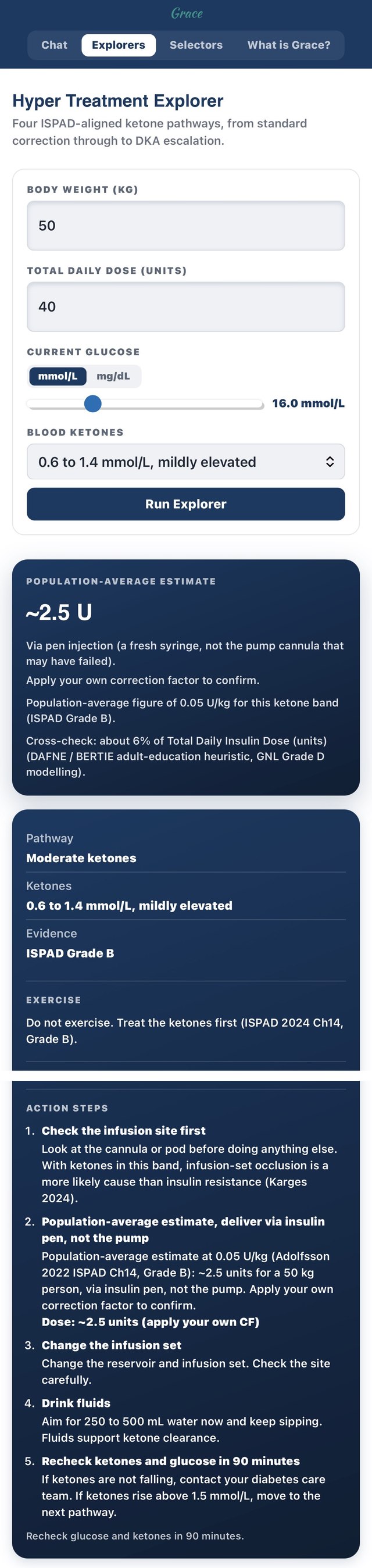
SmartGuard’s five-minute auto-corrections catch a lot of highs before they need anything else, but a high with rising ketones is a different situation, one the algorithm does not manage on its own. Auto-correction keeps delivering against its fixed 6.7 mmol/L (120 mg/dL) correction threshold; it does not check for ketones and does not know if a set has failed. A rising glucose that auto-correction is not bringing down, especially alongside nausea or abdominal pain, needs the same ketone check and sick-day pathway as it would on any other therapy.
This is a live capture of GNL’s free Hyper Treatment Explorer, another of the tools on the Grace page. To find it: open theglucoseneverlies.com/gnl-grace, accept the one-off consent step, choose the Explorers tab, then Hyper Treatment Explorer. The snippet below shows the input side and the output it produced. Enter your own weight, TDD, glucose, and ketone reading, and select your own system under Therapy or AID, for your own estimate.
The technical detail: why auto-correction is not a ketone response
Auto-correction is a basal and bolus response to a glucose number and a target, nothing more. It has no ketone input, so it cannot distinguish an ordinary high from one driven by insufficient insulin delivery, a failed cannula, or illness, the situations where ketones actually matter. A site that has stopped delivering insulin can sit alongside a rising glucose trace that looks, on the screen, like any other high SmartGuard is working on.
A glucose stuck above 15.0 mmol/L (270 mg/dL) for a couple of hours, with no missed-bolus explanation, usually points to a delivery problem rather than a high that just needs a correction, so it is worth checking the cannula.
Under-5s
The 780G is CE marked from age 2, and the ladder above carries its own preschool floor: from 2 to 6 years old, every level holds at the same 6.7 mmol/L target, the highest of the three age bands. That higher floor is deliberate, not a weaker setting, it trades some time-in-range for a wider hypoglycaemia safety margin at an age where reserve is lower and eating and activity are far less predictable.
LENNY (Battelino et al. 2025, Lancet Diabetes & Endocrinology 13(8):662-673), a randomised crossover trial in 98 children aged 2 to 6, is the evidence behind that European approval down to age 2: auto mode improved time in range by 9.9 percentage points and HbA1c by 0.61 percentage points over manual mode with suspend-before-low, with no severe hypoglycaemia.
SmartGuard doesn’t touch carb ratio, so, as with every AID system, getting the insulin-to-carb ratio right for a preschooler sits with you and the care team, not the algorithm. Preschoolers commonly need a stronger ratio than the standard adult starting point: ISPAD 2024 Chapter 23 advises the 330 or 250 rule rather than 500 for this age band, and breakfast ICR often needs to be tighter still, around 150 / TDD, reflecting the dawn-phenomenon insulin resistance seen in young children. These are population-average starting points, the actual ratio for an individual child depends on weight and total daily dose as well as age band, so treat them as a starting point for the conversation with your diabetes team, not a number to apply directly.
The trade-off to hold. The preschool floor is set high on purpose. A parent watching for tighter numbers may see the 6.7 mmol/L target as the system underperforming; it is the system protecting against a hypo risk that a young child often can’t communicate or self-treat. Any move off that floor is a conversation with the diabetes care team, not a setting to push on your own.
Under-5s are often sensitive to insulin around midday, and the 780G only runs one glucose target across the full 24 hours, it can’t soften just that window on its own. Using Temp Target from around 11am to 3pm is a way to work around it.
Listen: Mastering the MiniMed 780G
Want to listen to the podcast? Episode 3: Mastering the Medtronic 780G, The Hulk of AID explores how SmartGuard auto-corrections work, how to optimise settings, and how to manage exercise, high-fat meals, and hypo prevention.
For the wider picture across all four systems: Episode 6: Ten Tips to Optimise Time in Range, paired with the Top 10 Tips to Optimise Time in Range: AID Systems page.
Check out the podcast for a deeper understanding of the 780G and how to get the most out of the system.
Notes
Regulatory detail, evidence depth, and framing caveats behind this page
- GNL Insights. The GNL Insights boxes through this guide are the team’s own perspective and clinic experience: opinion and pattern-recognition, not a stated clinical fact or a personalised recommendation, distinct from the sourced claims and citations elsewhere on this page.
- Regulatory detail (System profile). The 780G pump is FDA-cleared as an ACE pump (K251032); SmartGuard is FDA-cleared as an iAGC (K251217). Paired with the Instinct sensor, the system meets the full interoperable-AID definition; paired with Guardian 4 or Simplera Sync, the pump and algorithm are interoperable-class but the sensor is not, so the system is partially interoperable in the strict regulatory sense. This is a technical distinction, not a functional one, all three sensor pairings work as intended day to day.
- Not a MiniMed-endorsed configuration (Optimising 780G: the five-level ladder). The five-level ladder is a GNL educational synthesis, graded D on a Grade A and B evidence base. The ladder, and the settings adjusted at each level, were reviewed and refined with input from the CamAPS, MiniMed, Tandem and Insulet global medical leads; that input shaped which levers are exposed and how they are described, but the levels are not validated against any manufacturer’s simulator or proprietary data, so this is not a manufacturer endorsement. Any settings change is a conversation with your diabetes care team.
- Evidence depth (Exercise). The wiki’s per-device exercise sourcing for 780G is thinner than for some other systems (CamAPS FX: Royston 2024, n=7,464). The Temp Target mechanism itself is well documented; population outcome data specific to 780G exercise use is a gap worth closing with fresh sourcing.
- Population-average framing (Meals). The high-fat and high-protein starting points above are population-average (Pemberton 2021 matrix; Bell 2014/2015/2016/2020; Pankowska 2009/2012). Individual responses vary, and any change is a conversation with your diabetes care team.
MiniMed 780G Knowledge Check
That was how the MiniMed 780G thinks and how to set it up to work with you. A short assessment on it follows, and 9 out of 10 earns your certificate.
References
Key papers behind this page. Tap to expand.
Real-world outcomes and settings
- Choudhary P et al. (2024). Real-world performance of MiniMed 780G. Diabetes Technology and Therapeutics. 26(Suppl 3):S32-S37. n=101,629. DOI: 10.1089/dia.2023.0433.
- Bassi M et al. (2025). Recommended-settings switch in MiniMed 780G. Frontiers in Endocrinology. 16:1670266. n=91. DOI: 10.3389/fendo.2025.1670266.
- Al-Sofiani M et al. (2026). MENAT real-world registry. Diabetes Technology and Therapeutics. n=7,965.
Head-to-head and safety
- Beato-Vibora PI et al. (2024). 780G vs Control-IQ, no significant TIR difference. Diabetes Care. n=150. DOI: 10.2337/dc23-1355.
- Karges B et al. (2024). DPV registry, hypoglycaemic coma and DKA rates across AID systems. n=13,922.
Paediatric and meal-timing evidence
- Battelino T, Kuusela S, Shetty A, et al; LENNY study group (2025). Efficacy and safety of automated insulin delivery in children aged 2-6 years (LENNY): an open-label, multicentre, randomised, crossover trial. Lancet Diabetes and Endocrinology. 13(8):662-673. n=98. DOI: 10.1016/S2213-8587(25)00091-9.
- ISPAD 2024 Chapter 23. Paediatric insulin-to-carb ratio guidance.
- Biester T et al. (2023). DPV registry, under-6 diurnal insulin-need pattern. Diabetes Technology and Therapeutics. n=25,718.
- Pemberton (2021 matrix). High-fat and high-protein dosing synthesis, GNL internal.
Pregnancy
- Benhalima K, Beunen K, Van Wilder N, et al. (2024). Advanced hybrid closed-loop in pregnant women with type 1 diabetes (CRISTAL): a randomised controlled trial. Lancet Diabetes and Endocrinology. 12(6):390-403.
MiniMed 780G