
CGM Device Guide
MiniMed Simplera Sync and Instinct
Two sensors, two ways to use them: the MiniMed 780G pump for automated insulin delivery, or the MiniMed Go app for multiple daily injections, both pairing with either Simplera Sync or Instinct. Inside the 780G, the real decision is wear duration, Simplera Sync’s seven days against Instinct’s fifteen; everything else is close enough not to be the deciding factor. Availability varies by country and region.
Ask Grace
Want to talk through Simplera Sync or Instinct alongside your current setup? Ask Grace.
MiniMed Simplera Sync and Instinct at a glance
- The one real choice: wear duration, Simplera Sync 7 days vs Instinct up to 15 days, roughly halving sensor changes a month
- ±20/20 agreement: Simplera Sync 89% adult, 88% paediatric; Instinct 94% (inherited from FreeStyle Libre 3 Plus, same Abbott hardware)
- Calibration: both factory calibrated; Simplera Sync may prompt occasional confirmation checks, a real finger-prick, not the CGM reading typed back at itself
- AID compatibility: MiniMed 780G only, for both sensors, no other pump or AID system
- Age indication: both 2 years and older at system level (UK/EU); US system-level age differs, see Device specifications
- Both have an MDI sibling: MiniMed’s Smart MDI system (MiniMed Go) pairs the InPen smart insulin pen with either sensor, covered further down
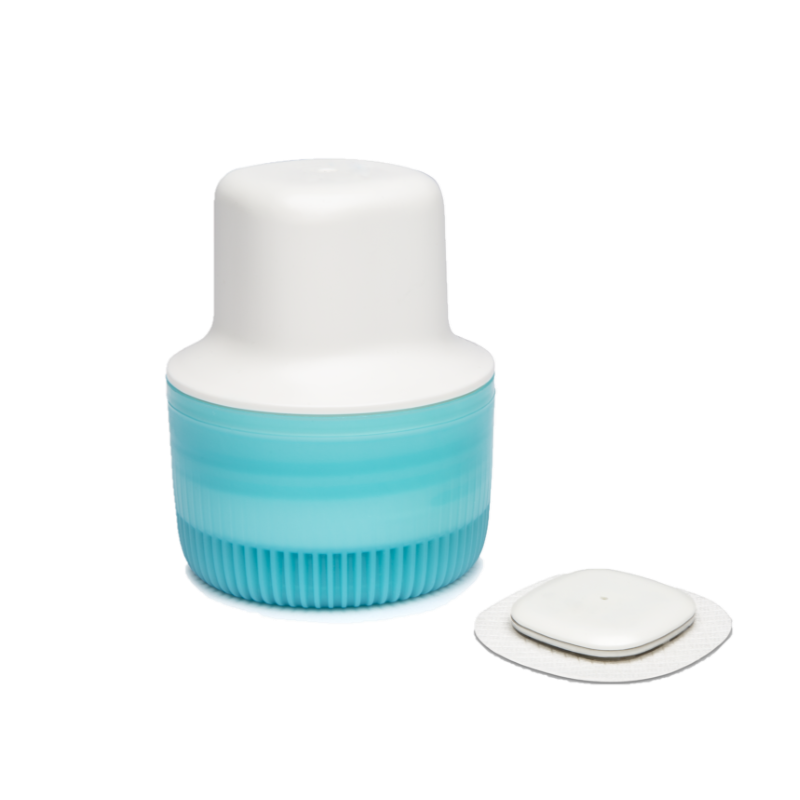 Simplera Sync applicator and sensor
 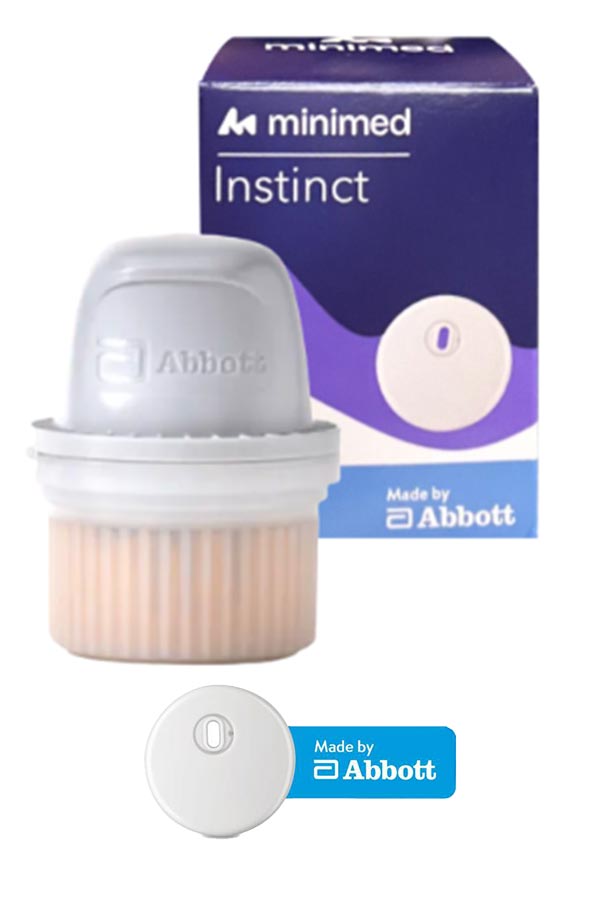 MiniMed Instinct sensor, made by Abbott
 Framework status
Data sufficiency: Simplera Sync met via its pivotal trial (n=243, no serious adverse events, FDA approval April 2025). Instinct met by inheritance, same Abbott sensor hardware and evidence base as FreeStyle Libre 3 Plus.
Using Simplera Sync and Instinct day to day
Reading a sensor is the easy part. Knowing what to do when it alarms before breakfast, or what to give before PE on a wet Tuesday, is the part that takes practice. Survive and Thrive is a short practical guide to using either sensor in the situations that actually come up, written to be printed and kept where it is needed rather than read once and closed.
Two systems that look alike and behave differently, so each gets its own guide. Working out which of those differences matter at home, and which are just specification, took more than ten years of clinic days with children and families living with this. Both guides are cut to the minimum effective dose.
Why it is called Survive and Thrive. Whichever of the two you use, the learning goes the same way round. Survive first: the low, the high that has run long enough to need ketones, the reading not to take at face value. Those are the rules that keep the early weeks safe. Thrive second, once the first part no longer takes any thinking and the questions turn to getting more out of the system on an ordinary day. Both guides are written in that order, drawing on the published evidence and on clinic experience in equal measure, with a little personalisation in each: the carbohydrates you keep to hand are your own, and Grace will scale the figures to a weight you enter.
Each sensor has its own guide, because the two do not behave identically. Open the one you use.
Make one with your own weight in it
The guides below are worked examples at 60 kg; you can build your own with your weight and the carbohydrates you keep to hand, scaled from the same population averages.
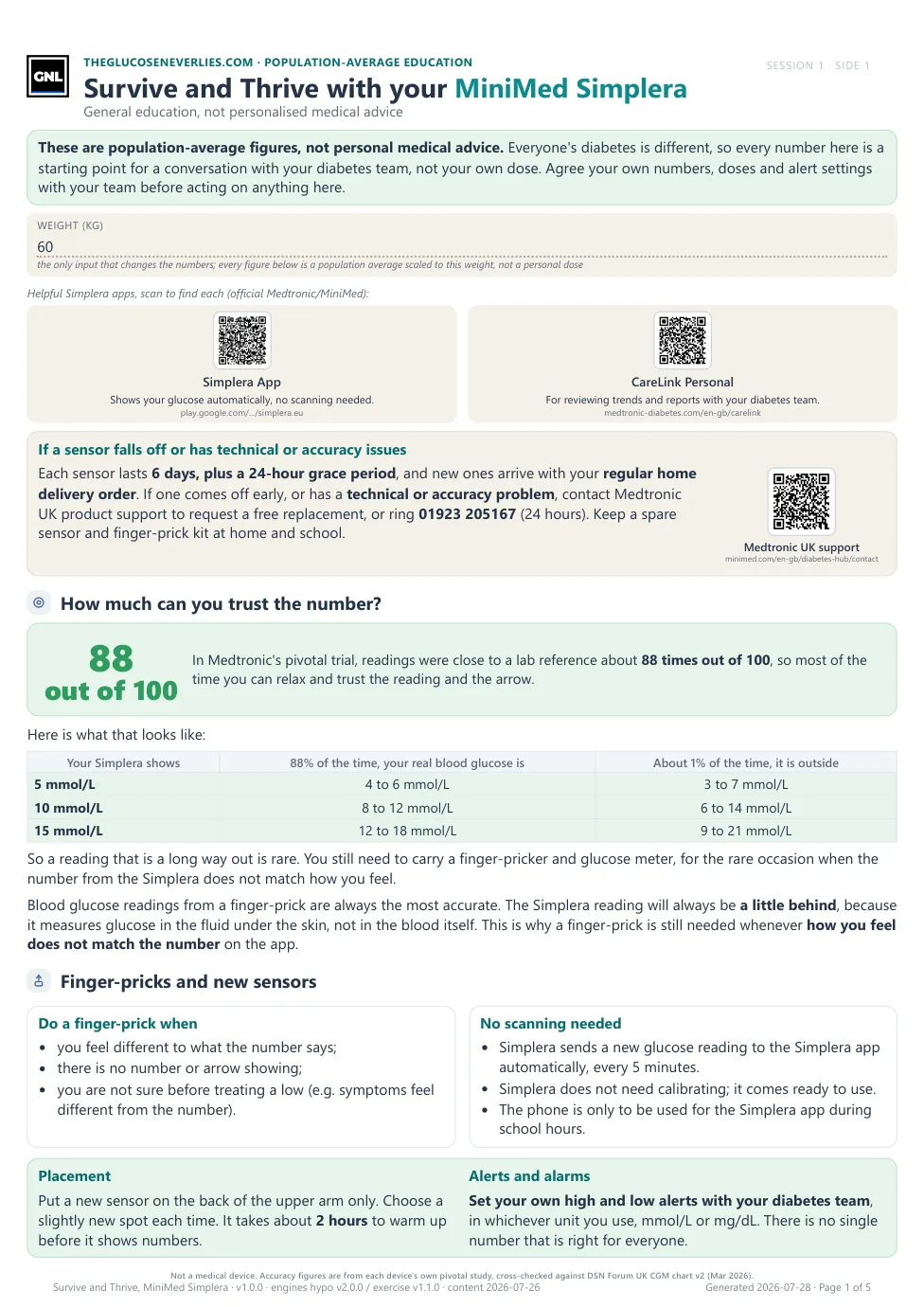
Simplera Sync, the one-page guide
What it walks you through.
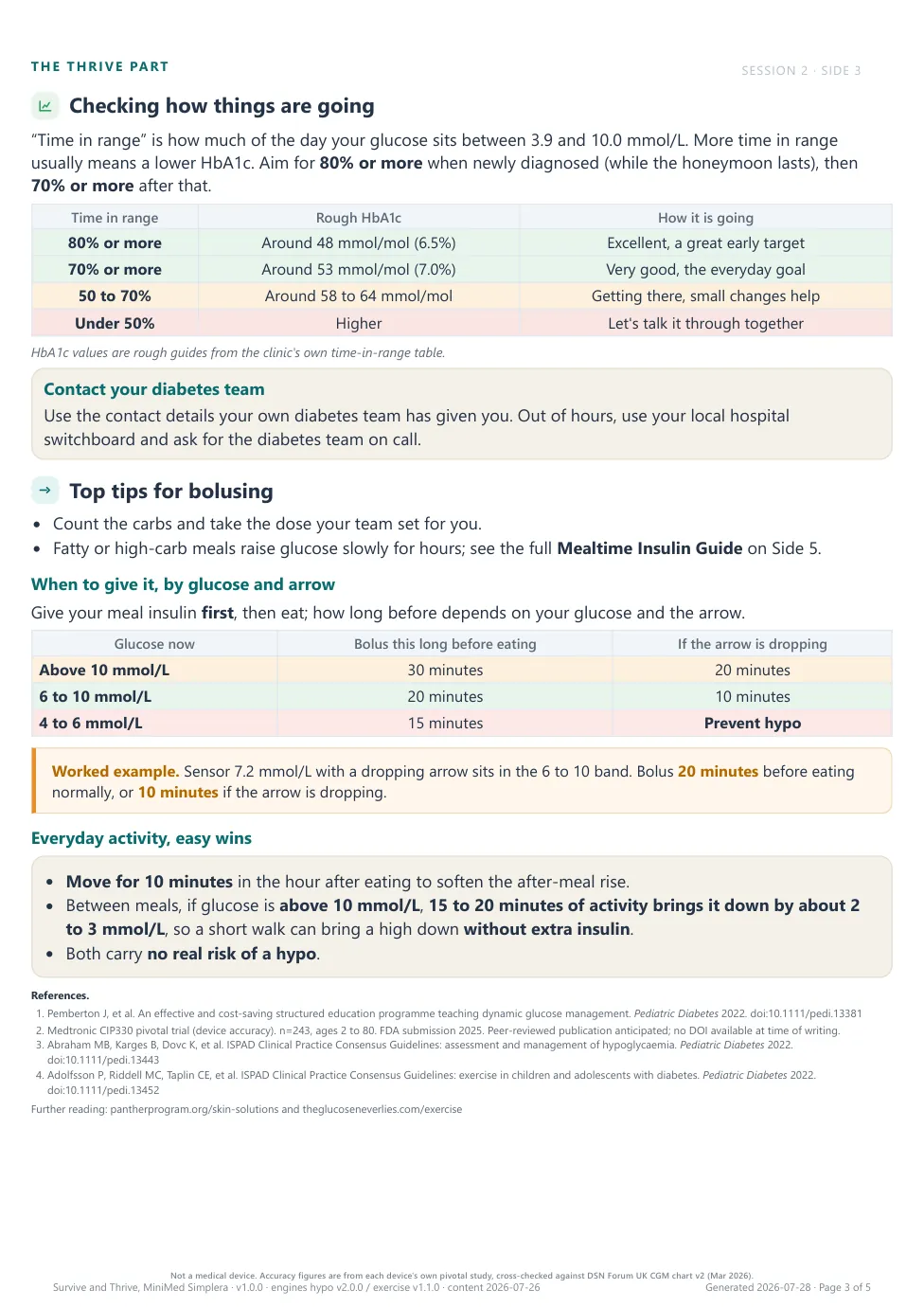
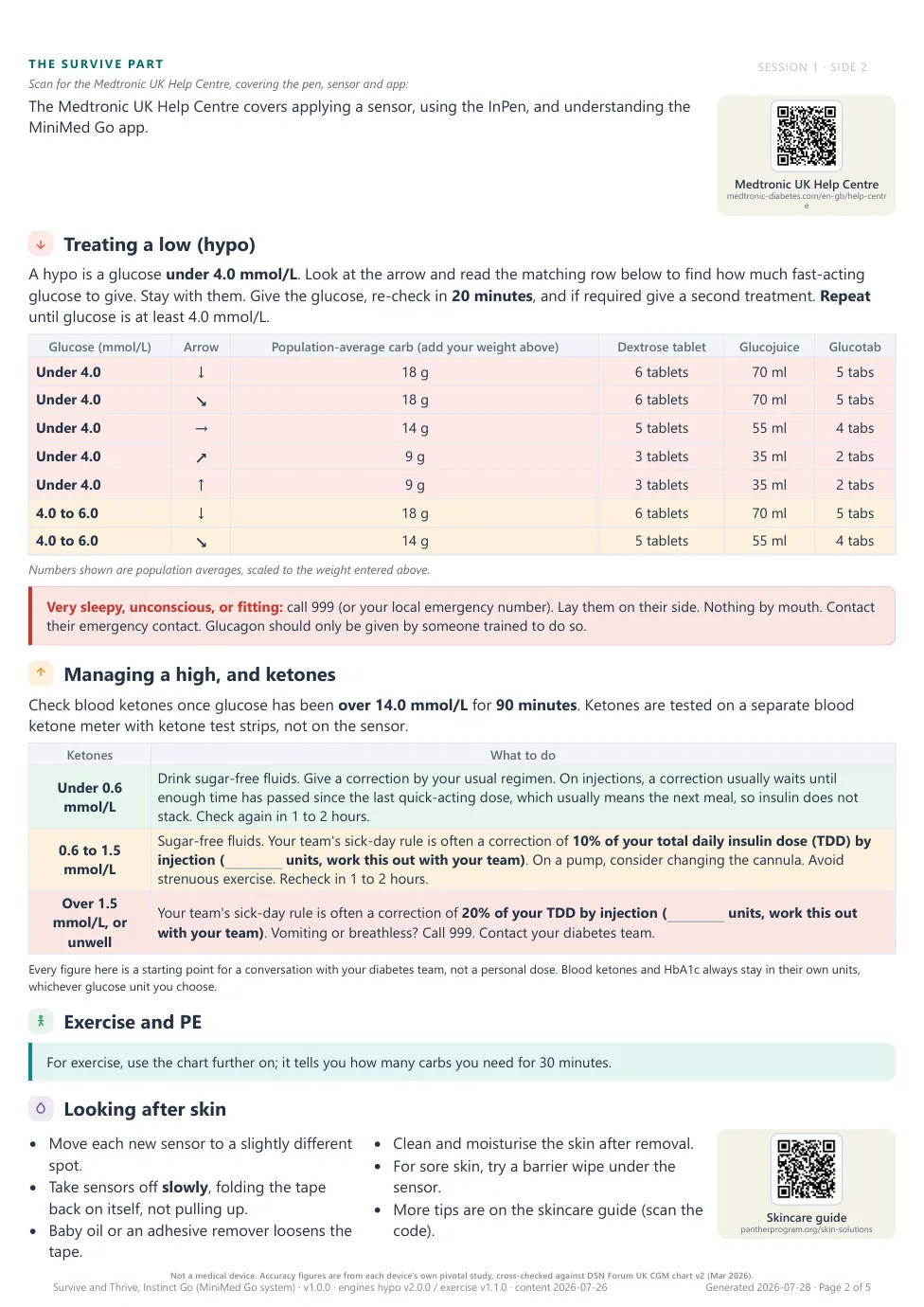
- Treating a low. Reading the glucose and the trend arrow together, and what that points to in grams of fast-acting carbohydrate, with the re-check timing.
- Highs and ketones. When a high has gone on long enough to check ketones, and what each ketone band means.
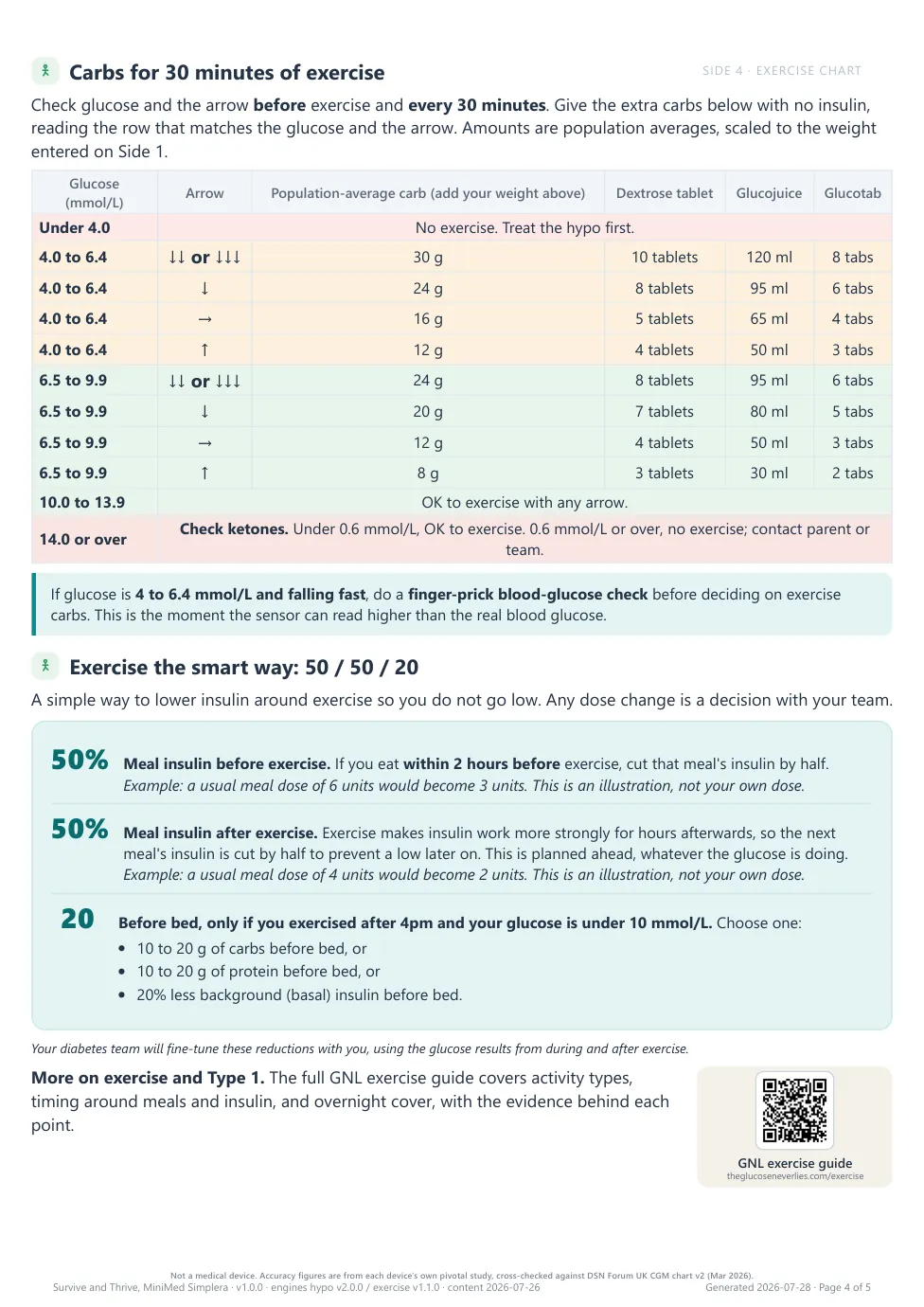
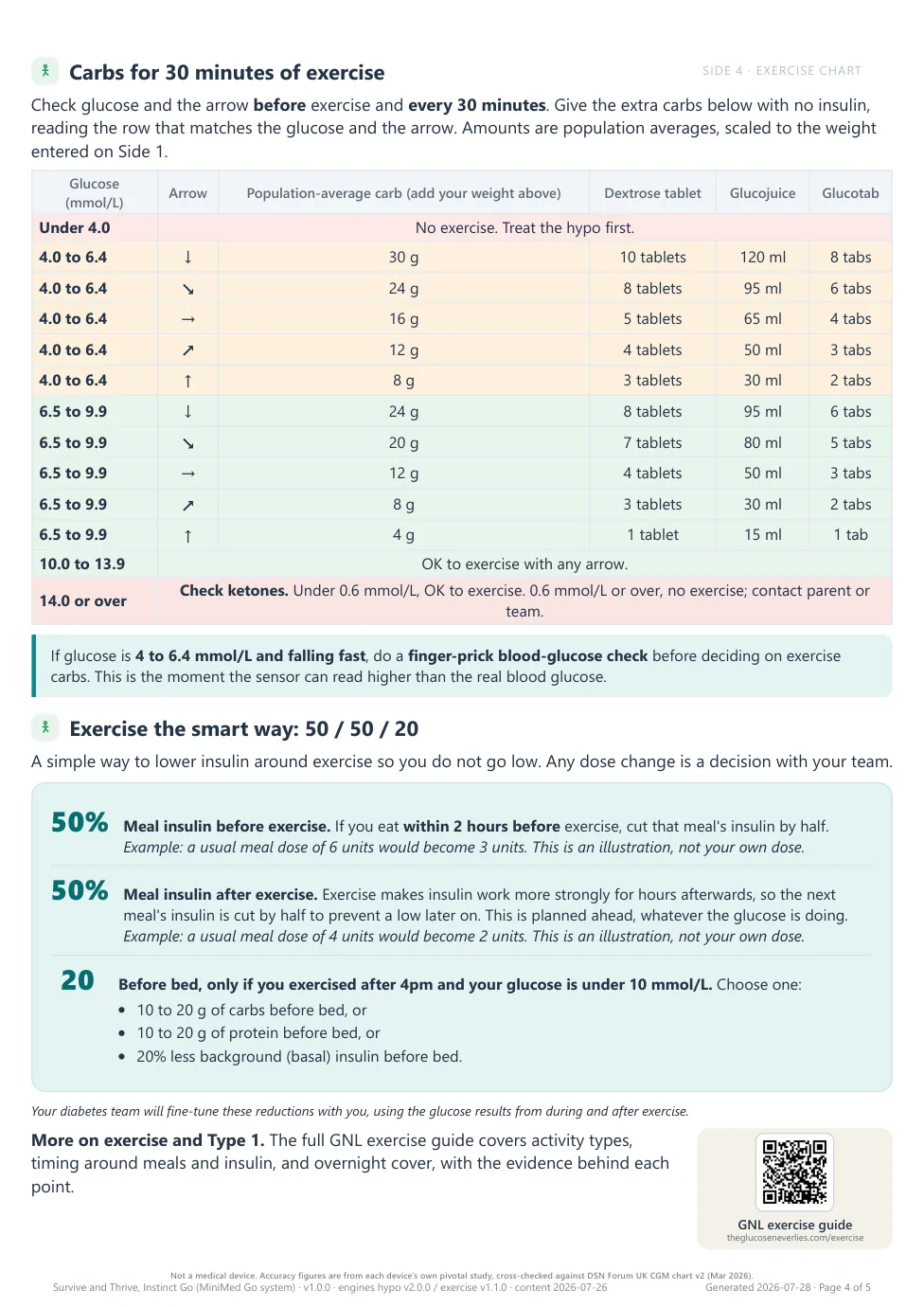
- Exercise. Carbohydrate for thirty minutes of activity, read off the same glucose-and-arrow pair, plus the insulin planning around it.
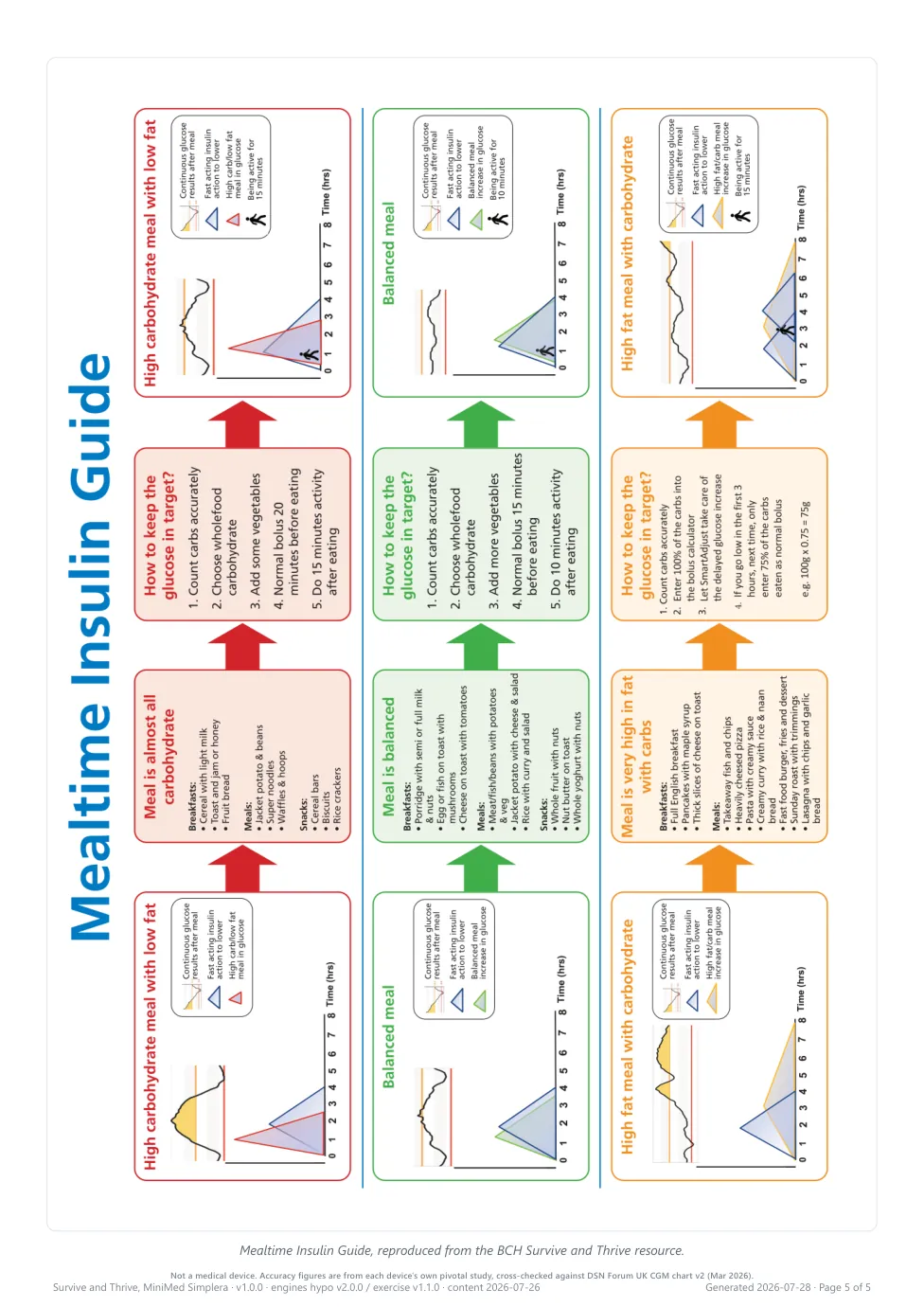
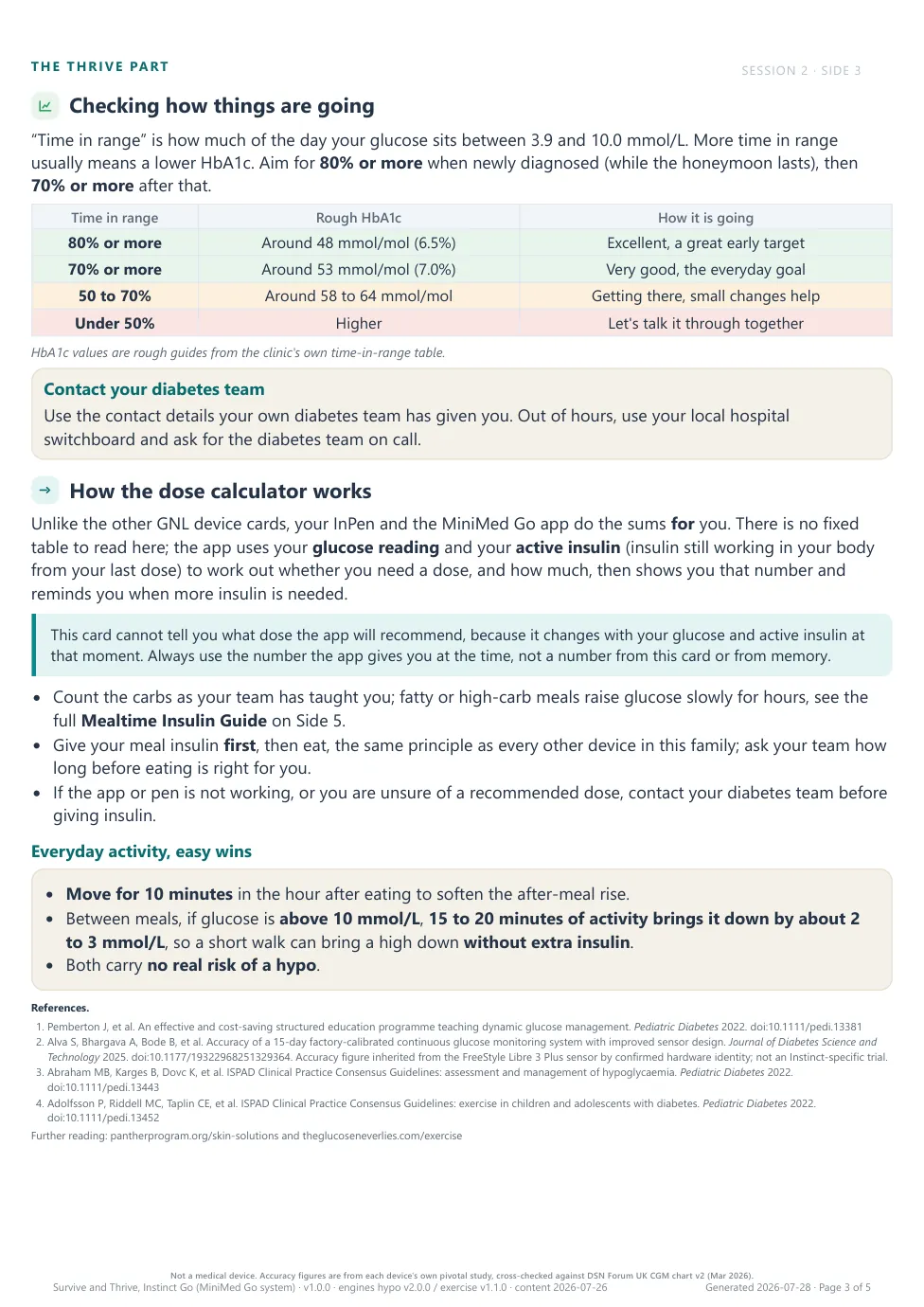
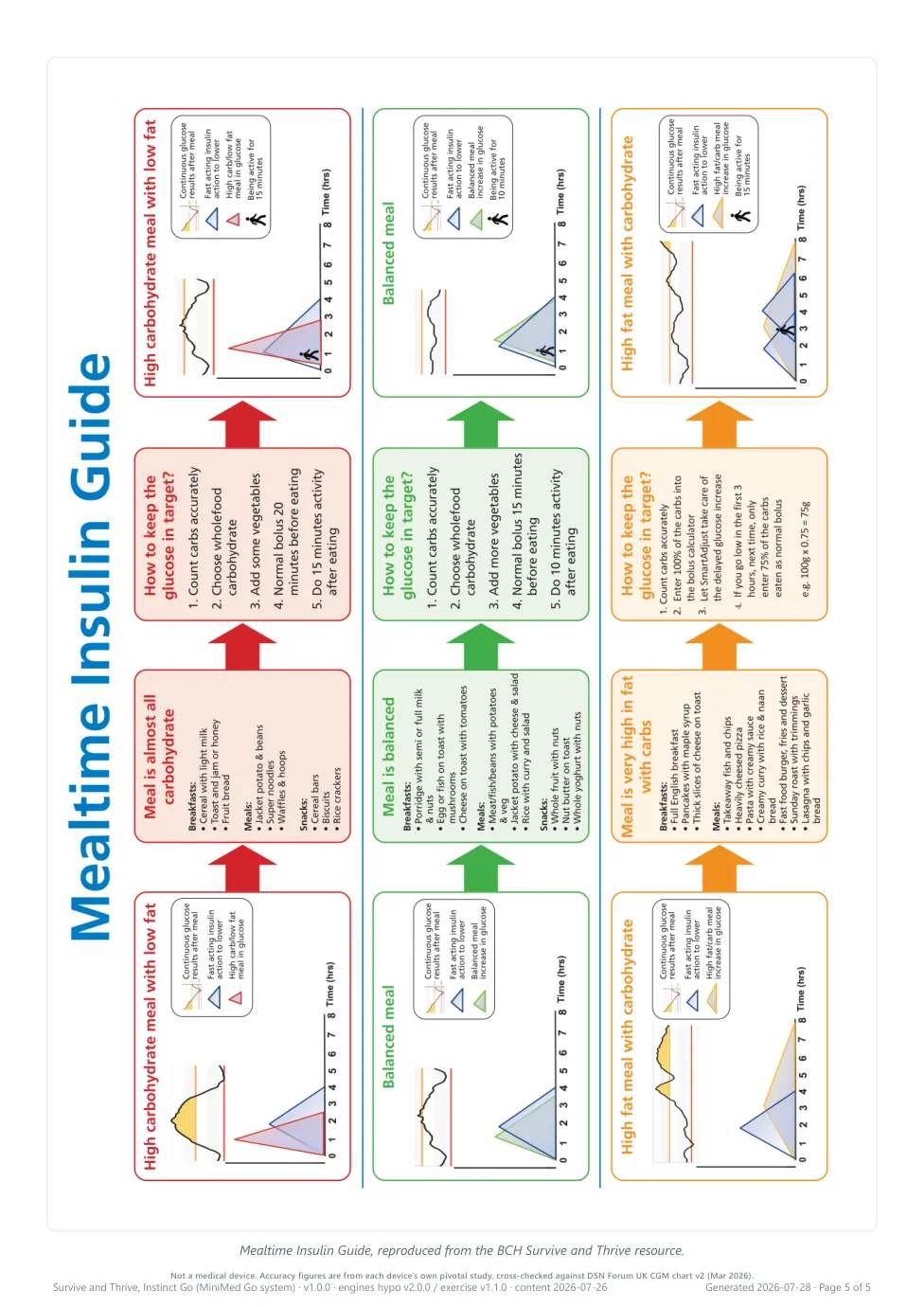
- The everyday things. When a finger-prick still matters even with a sensor on, looking after the skin underneath, and how mealtime insulin timing shifts with the arrow.
Two things worth knowing before you print it. The carbohydrate tables let you choose the three products you actually keep to hand, so the grams come out as that many tablets, millilitres or sweets rather than as a number to convert under pressure. And the trend arrows are drawn the way this sensor draws them, so the row you are looking for on paper matches the glyph on the screen.
Every figure on it is a population average scaled to a body weight. It is a starting point for a conversation with your diabetes team, not a personal dose, and the card says so on every side.
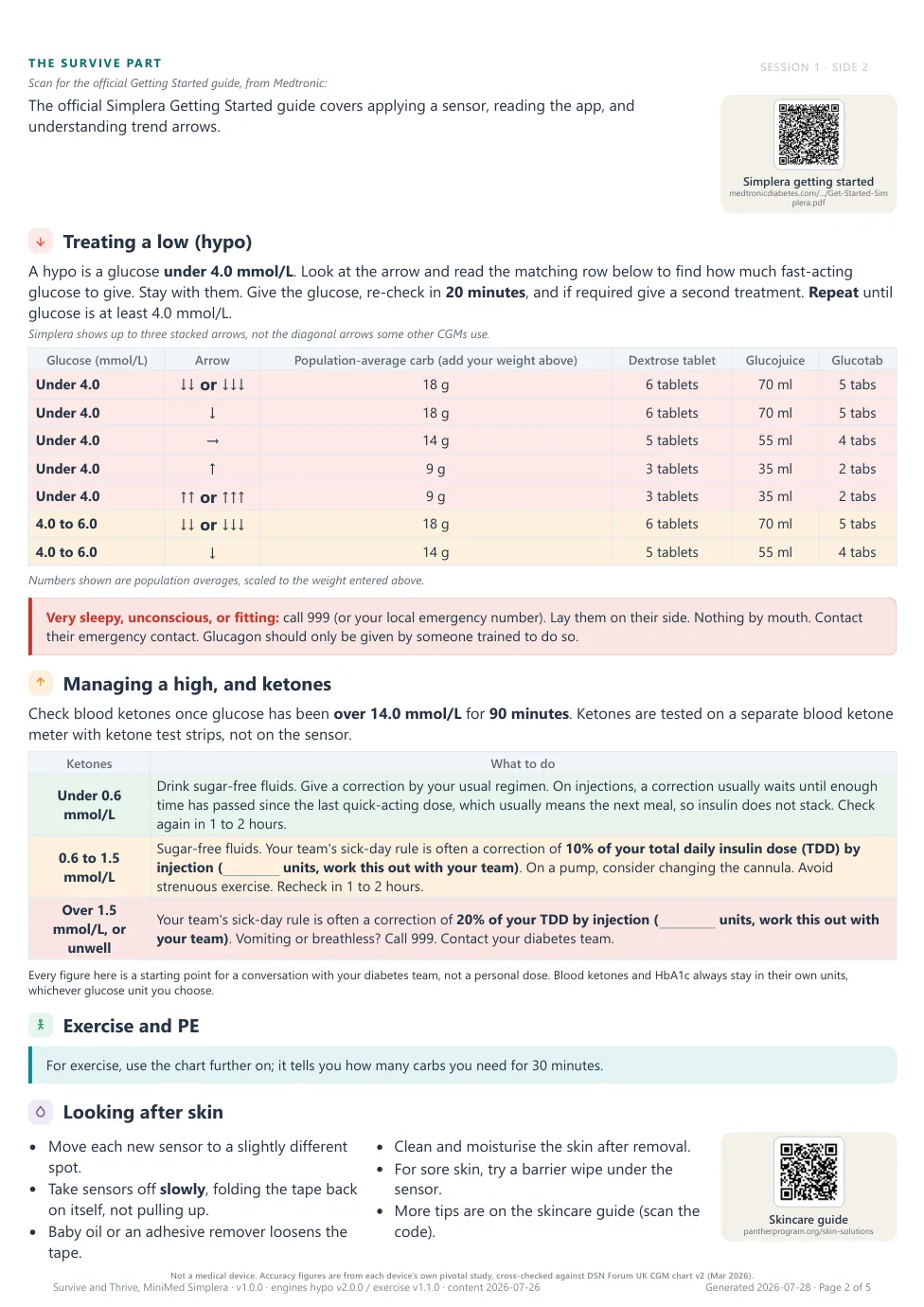
Instinct Go, the one-page guide
What it walks you through.
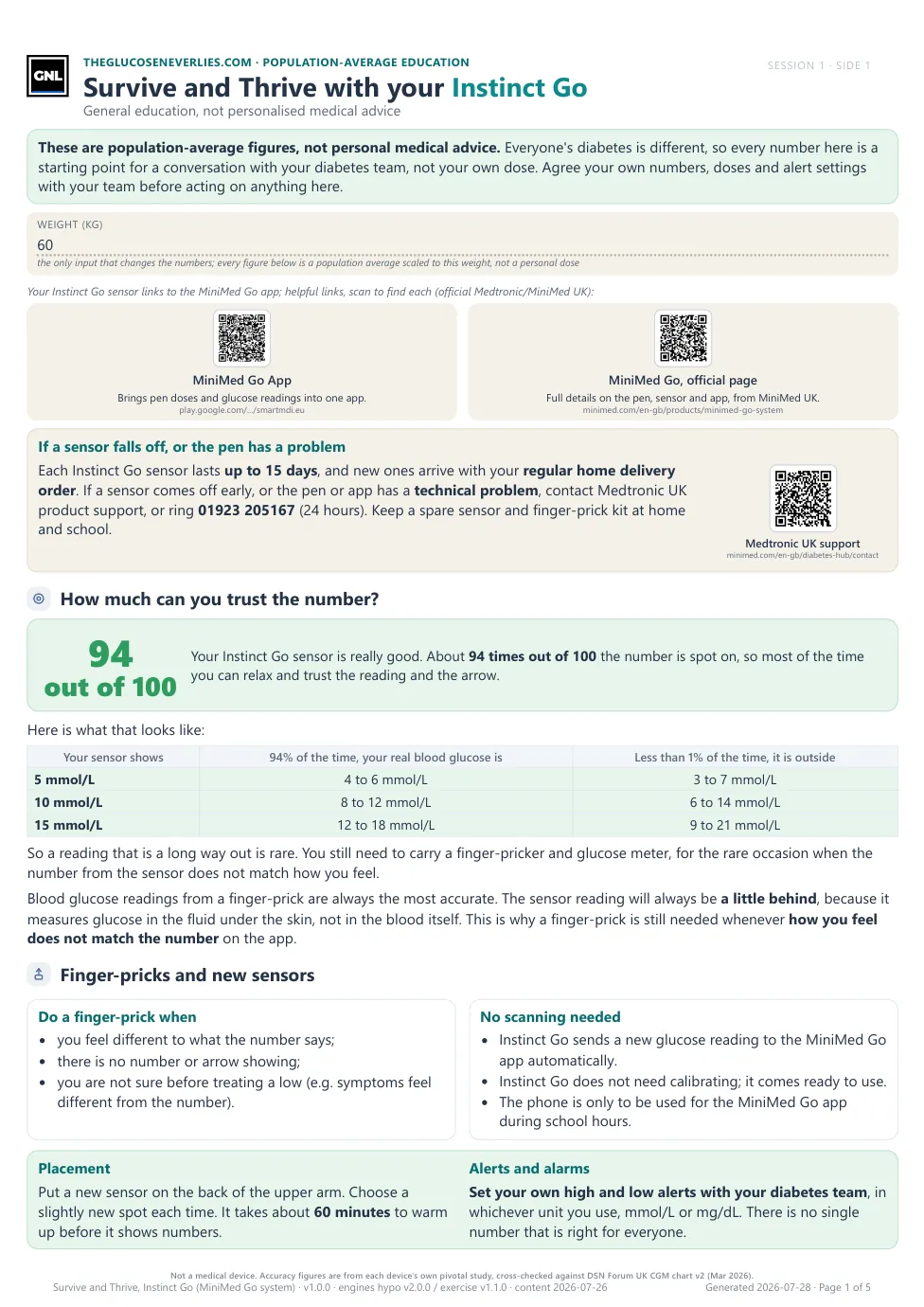
- Treating a low. Reading the glucose and the trend arrow together, and what that points to in grams of fast-acting carbohydrate, with the re-check timing.
- Highs and ketones. When a high has gone on long enough to check ketones, and what each ketone band means.
- Exercise. Carbohydrate for thirty minutes of activity, read off the same glucose-and-arrow pair, plus the insulin planning around it.
- The everyday things. When a finger-prick still matters even with a sensor on, looking after the skin underneath, and how mealtime insulin timing shifts with the arrow.
Two things worth knowing before you print it. The carbohydrate tables let you choose the three products you actually keep to hand, so the grams come out as that many tablets, millilitres or sweets rather than as a number to convert under pressure. And the trend arrows are drawn the way this sensor draws them, so the row you are looking for on paper matches the glyph on the screen.
Every figure on it is a population average scaled to a body weight. It is a starting point for a conversation with your diabetes team, not a personal dose, and the card says so on every side.
Device specifications
The full side-by-side profile is below for anyone who wants the detail.
| Feature | Simplera Sync | Instinct |
|---|---|---|
| Manufacturer | MiniMed (formerly Medtronic Diabetes) | Abbott, made exclusively for MiniMed |
| Wear duration | 6 days plus 24-hour grace period (6.5 days total) | Up to 15 days (8 to 15 days per ADCES/danatech spec sheet) |
| Design | All-in-one disposable, transmitter and sensor integrated in a single oval pod | Single-piece, fully disposable sensor and transmitter |
| Warm-up | Approximately 2 hours | Approximately 1 hour |
| Calibration | Factory calibrated; may prompt occasional confirmation checks (a real finger-prick, not the CGM reading re-entered) | Factory calibrated, no required calibration |
| Placement | Upper arm only | Upper arm (provisional, not yet formally confirmed in public labelling) |
| Age range, with the MiniMed 780G | Europe (CE): 2 years and older. US (FDA): 7 years and older. Full regulatory detail on the MiniMed 780G page. | |
| AID compatible | MiniMed 780G only | MiniMed 780G only |
| Smartphone app / caregiver follow | MiniMed Mobile app (same app for both sensors, since it pairs with the 780G pump); caregiver follows via the separate CareLink Connect app | |
Data syncs from the MiniMed Mobile app to CareLink, which splits the same way LibreView does for FreeStyle Libre: CareLink Personal for the person wearing the pump to review their own data, and CareLink Clinic (also sold as CareLink Pro) for the diabetes team to review it in clinic. Neither sensor talks to the FreeStyle Libre app, LibreLink, or LibreView, even though Instinct shares its hardware with the Libre 3 Plus. Availability varies by country and region; verify current market status with MiniMed before a market-specific clinical conversation.
The age-indication table is the part people skim past and then get caught out by. A 6-year-old on a 780G in the UK is fine on either sensor; the same child’s US-based cousin on SmartGuard needs to be 7. The system label, not the sensor label, is usually the binding one.
Accuracy
The two sensors reach their accuracy figures by different routes: Simplera Sync through its own dedicated pivotal trial, Instinct by inheriting the FreeStyle Libre 3 Plus dataset outright, since it is the same Abbott sensor hardware under MiniMed software. Neither route is weaker than the other; they are simply different evidence shapes.
| Metric | Simplera Sync | Instinct |
|---|---|---|
| Framework score | 5/5 | 5/5 |
| ±20/20 agreement | 89% (adult), 88% (paediatric) | 94% (inherited from FreeStyle Libre 3 Plus) |
| Outside ±40/40 | 1% | Not established (no chart row for this hardware generation; not borrowed from another device’s figure) |
| Evidence source | Dedicated pivotal trial, n=243, ages 2 to 80, Medtronic FDA submission 2025 | ±20/20 inherits FreeStyle Libre 3 Plus’s FDA-reviewed accuracy evidence directly, same sensor hardware; the ±40/40 figure is not part of that inheritance and is not yet captured |
“Instinct is more accurate than Simplera Sync” is the tempting one-line takeaway, and it undersells what is actually going on: the two studies used different designs entirely, one bespoke and one inherited. Worth reading as two different evidence shapes rather than a simple leaderboard.
AID system compatibility
Both Simplera Sync and Instinct are locked to the MiniMed 780G. Neither works with any other AID system: not Omnipod 5, not Tandem Control-IQ or Control-IQ+, not CamAPS FX. This is a structural difference from the rest of this CGM cluster, where a single sensor typically pairs with several pump ecosystems. On the 780G, the choice of AID system and the choice of sensor are the same decision; there is no separate sensor-shopping step once the pump is chosen.
People coming from Dexcom or Libre sometimes look for a sensor-switching conversation the way they would on another pump; on the 780G there is not one. Choosing the pump chooses the sensor family; the only remaining question is which of the three sensors inside that family.
Simplera Sync
Simplera Sync only exists inside a 780G. Take the pump away and the sensor has nothing to talk to. Inside it, this is what it actually brings.
One piece, not two
Sensor and transmitter live in a single oval pod. No clip to charge, no clip to lose. Anyone who has spent a year hunting for a missing Guardian transmitter will feel the difference immediately.
Calibration you never do, checks you occasionally do
No finger-pricks for calibration, full stop. The system may still ask for an occasional confirmation check, and that check has to be a real finger-prick, not the CGM number typed back at itself. Type the CGM reading into its own confirmation and the loop has no way out.
89% within ±20/20 adult (88% paediatric), and the number that matters more
The pivotal trial, n=243, ages 2 to 80. But inside a running 780G, the figure that actually protects someone is that SmartGuard held them in mode 93% of the time, algorithm safety constraints doing some of the work an open-loop reading would leave entirely to the wearer.
Instinct
Instinct does not need its own accuracy study, and this page is not going to pretend it does. It is the FreeStyle Libre 3 Plus sensor, built by Abbott, wearing MiniMed’s software. Same hardware, same ±20/20 accuracy: 94%, the same figure Libre 3 Plus already carries on this hub. No ±40/40 figure exists for this hardware generation; treated the same way as any newly launched sensor still building its own evidence base, not borrowed from another device.
Fifteen days, not seven
Roughly half the sensor changes a month of Simplera Sync or Guardian 4. That is the whole pitch, and it is a genuinely good one.
Smallest of the three, quickest to start
Smaller than the current Simplera Sync pod (MiniMed’s own description), with roughly an hour’s warm-up against Simplera Sync’s two.
Same sensor, closed door
It will not talk to LibreLink, LibreView, or any pump that is not a MiniMed. Sharing hardware with FreeStyle Libre 3 Plus does not make them the same product, and the two are not interchangeable in either direction.
MiniMed Go, a different system entirely, and both sensors link to it
Do not confuse this with the 780G. MiniMed Go is a smart pen (InPen) plus a sensor plus an app, built for multiple daily injections, not a pump. It is MDI, not AID, and it exists for the majority of people with type 1 diabetes worldwide who are on injections, not a pump, and who have mostly gone without this kind of tech support until now. Both sensors work with the MiniMed Go system. Regional availability varies.
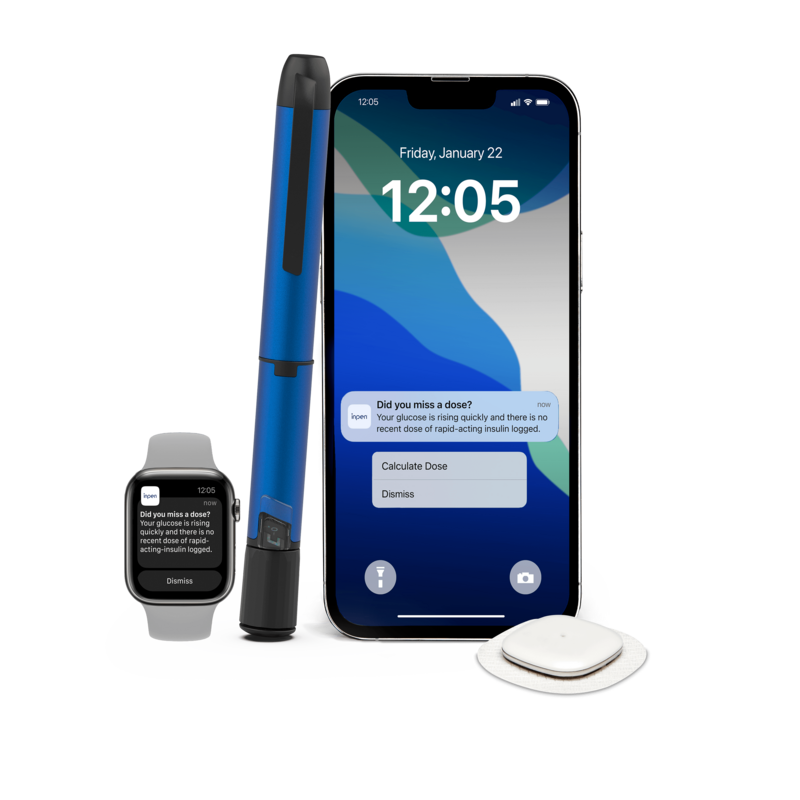 Same Simplera sensor, in its MiniMed Go pairing
 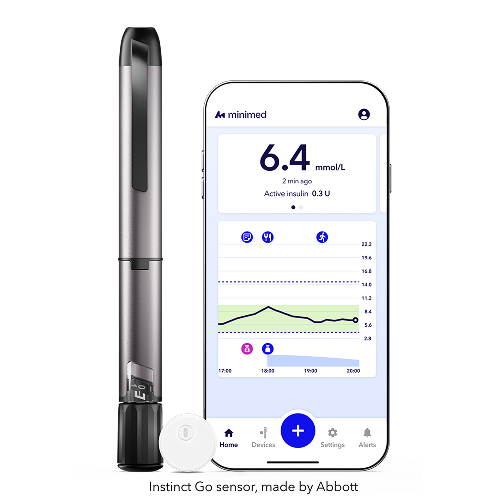 Same Instinct hardware, as Instinct Go in the MiniMed Go pairing
 No more wondering if you have dosed
The smart pen captures every injection automatically and logs it against the CGM trace. The daily guesswork of “did I already bolus for lunch” goes away, not because anyone remembers better, but because the pen does.
Bolus support without a pump
Dose guidance informed by CGM data, the kind of decision support pump users take for granted, now available to someone who has chosen injections and has no intention of changing that.
A wide paediatric reach
Licensed from age 2 (with adult supervision for ages 2 to 6; standard licensing from 7), younger than the rival bolus-calculator apps on the market at the time of writing, which mostly stop at 18. For a young child on MDI, this is real tech support where there was previously little.
Family visibility, MDI included
Follower mode gives a parent or carer the same real-time view that AID families get. Being on injections rather than a pump should not mean going without that.
The sensor options inside MiniMed Go are the same Simplera and Instinct hardware covered on this page: Instinct Go is the MDI-branded variant of the same Abbott sensor, sharing the FreeStyle Libre 3 Plus hardware lineage. Same underlying sensors, different app, different regulatory record from the 780G; not interchangeable products even where the hardware is shared. A single MiniMed Go app now runs the whole system, replacing the earlier split between separate pen and sensor apps.
Notes
Regulatory detail, evidence depth, and framing caveats behind this page
- GNL Insights. The GNL Insights boxes through this guide are the team’s own perspective and clinic experience: opinion and pattern-recognition, not a stated clinical fact or a personalised recommendation. Numbered claims elsewhere on this page are sourced in the References below; GNL Insights are not.
- Two different evidence shapes, not a leaderboard. Simplera Sync’s accuracy comes from its own dedicated pivotal trial. Instinct’s accuracy is inherited directly from FreeStyle Libre 3 Plus, same Abbott sensor hardware, confirmed by John in writing 16 July 2026 (see `entities/instinct-sensor.md`). Neither route is weaker; a direct percentage-point comparison between the two is comparing two different kinds of evidence, not a strict head-to-head under one protocol.
- Instinct’s FDA interoperability status. Instinct carries the iCGM designation on the basis of its shared FreeStyle Libre 3 Plus hardware; this was confirmed by John in writing on 16 July 2026 and supersedes an earlier, more cautious provisional framing in the entity file. Simplera Sync, by contrast, is a standalone PMA Class III CGM (FDA product code SFI, not the iCGM code SAF), non-adjunctive within Medtronic AID systems only. The two sensors on this page sit on different sides of the FDA interoperability-class line even though both are locked to the same 780G pump.
- Instinct age indication, sensor level. Instinct is not yet listed as a standalone entry in the Pemberton 2026 clinical opinion paper’s device table, which predates the Instinct CE Mark. This page follows the entity file’s rule and quotes the SYSTEM-level age indication (the MiniMed 780G with Instinct) rather than inferring a standalone sensor age from Instinct’s Libre 3 Plus heritage.
- Availability. Regional availability varies for both sensors and for MiniMed Go Smart; verify current market status with MiniMed before a market-specific clinical conversation. A prior version of this page’s three-sensor diagram stated Instinct was “coming soon to the UK”, a country-specific claim not permitted under the locked regional-availability policy; corrected here to the generic form.
Simplera and Instinct Knowledge Check
You have read how the MiniMed Simplera Sync and Instinct sensors fit into daily life. A short assessment on them follows, and 9 out of 10 earns your certificate.
References
- CIP330 pivotal trial. Simplera Sync accuracy data, n=243, ages 2 to 80, Medtronic FDA submission 2025.
- MiniMed Group, Inc. “MiniMed expands sensor portfolio in Europe with CE Mark for MiniMed 780G system with the Instinct sensor, made by Abbott.” Press release, Northridge, California, 10 March 2026. Source of the three-sensor portfolio claim, Instinct specifications, and the MiniMed Go Smart CE Mark (Instinct Go sensor).
- ADCES / danatech. Instinct sensor spec sheet. Confirms wear duration, warm-up, calibration, smartphone compatibility, caregiver Follow, and US reimbursement detail.
- Alva S, Bhargava A, Bode B, et al (2025). Accuracy of a 15-day Factory-Calibrated Continuous Glucose Monitoring System With Improved Sensor Design. Journal of Diabetes Science and Technology 20(4):1122-1130. DOI 10.1177/19322968251329364. FreeStyle Libre 3 Plus accuracy evidence, inherited directly by Instinct (same sensor hardware); see the FreeStyle Libre guide on this hub for full sourcing. Corrected 2026-07-25 from an earlier “Abbott (2022, 2023)” citation that matched no dataset on file.
- Pemberton JS, Moser O, Zaharieva DP, et al. Continuous glucose monitoring: an international clinical opinion on transparency, standardisation, and calibration alignment. Diabetes Obes Metab. 2026;28(4):2551-2565. doi:10.1111/dom.70460.
- Medtronic. “Medtronic begins EMEA commercial launch of MiniMed Go Smart MDI system with Simplera sensor.” Press release, 25 February 2026. Source for the Simplera-paired MiniMed Go MDI system and its European launch date; confirms MiniMed Go eligibility from age 2 (adult-supervised 2 to 6, standard licensing from 7).
- Medtronic. “Medtronic Diabetes announces FDA clearance for MiniMed Go Smart MDI system featuring Instinct sensor made by Abbott.” Press release, 12 January 2026; US commercial launch May 2026. Source for the Instinct Go-paired MiniMed Go MDI system and its US regulatory timeline.
- MiniMed. “MiniMed launches Instinct sensors in Europe.” Press release, 23 June 2026. Source for the European launch of Instinct and Instinct Go.
Device 4 of 4
MiniMed Simplera Sync and Instinct