
The GNL Podcast
Episode 44, Jess Shaw: type 1 at the top of the game
A national trial where nothing went right, a diagnosis the same evening, and then ten years of making sure nobody on the team found out. Jess Shaw is now an England netball international, and this is her account of the years in between.
Ask Grace
Want to know why insulin already on board changes what a training session or a match does to glucose, and what the exercise guidelines say about it?
Listen
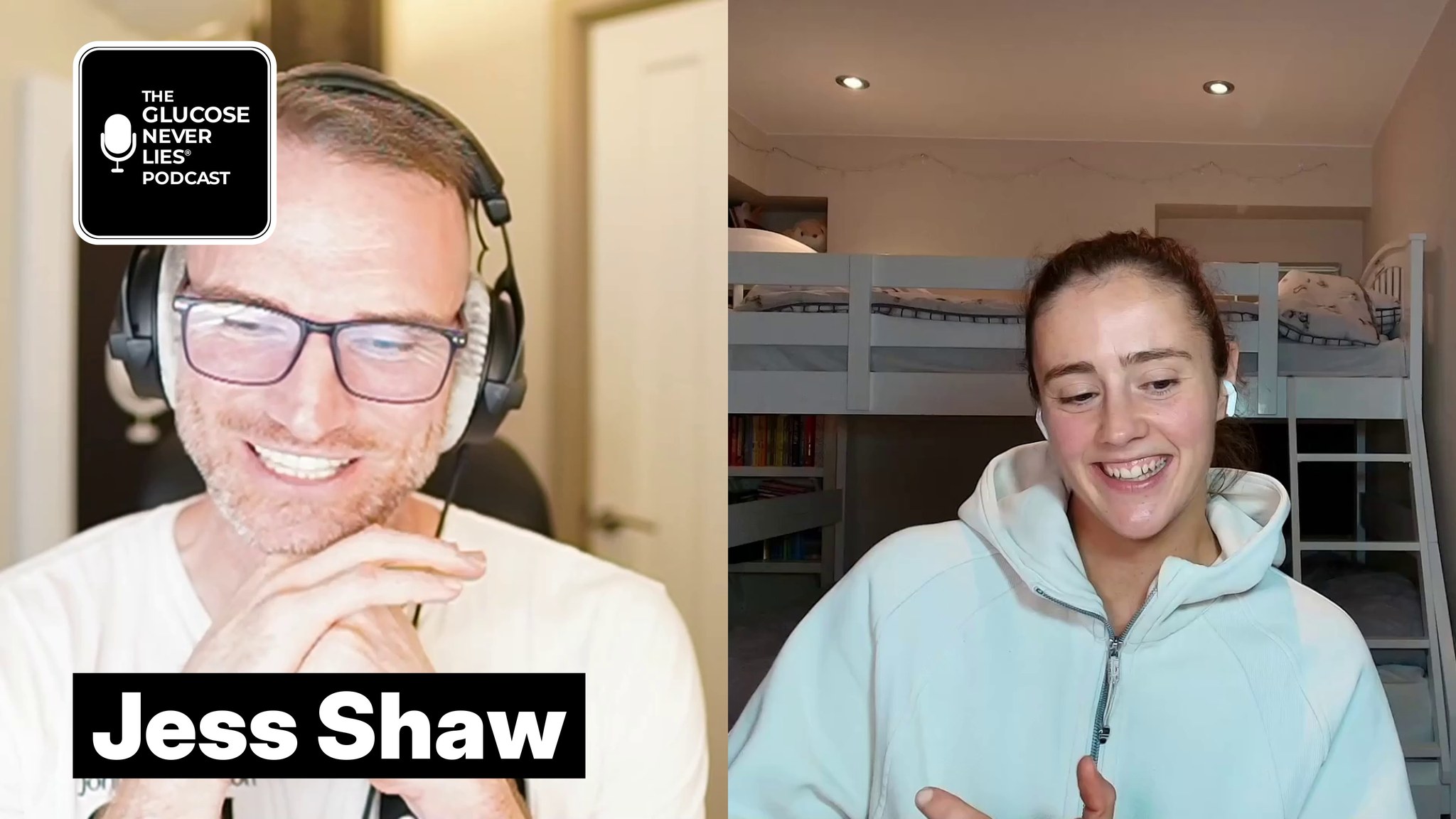
Available on Buzzsprout, Apple Podcasts, and Spotify. Guest: Jess Shaw, England netball international, living with type 1 diabetes. Host: John Pemberton.
Why this episode exists
If you have ever kept your diabetes quiet to keep your place in a team, you already know the arithmetic Jess describes: a low you hide costs you less, today, than a conversation you are not ready to have. She did that sum for ten years, at every level of the game, and she is honest about what it cost.
This is not a story about getting everything right. It is about a player, and the people around her, learning that talking about type 1 is part of performing with it. Clubs, schools and coaches carry a share of that, which is why the conversation keeps coming back to what a team needs to have in place before the day it matters.
In this episode
Jess and John met through the game, and the conversation starts where her type 1 did: an evening in Leeds after a trial where nothing worked. From there it runs through the first rules she was given, a run of lows that a good-looking HbA1c hid, and the years of telling nobody.
The second half is the career: Super League, injuries, a first England cap against Australia at a few days’ notice, game days on injections, and then the move to a closed loop, in Jess’s own words. John closes with what he heard, and Jess with a message to young players: you are not alone.
Episode chapters
- 00:00, Welcome: how John and Jess met
- 04:33, Diagnosis at 13: the Leeds trial
- 08:47, The first rules, and a lot of lows
- 15:08, Why the first messages stick
- 18:03, Moving to time in range
- 19:09, A low HbA1c that hid the lows
- 20:50, Ten years of hiding it
- 23:57, Sent home alone at 16
- 25:10, Why sport needs a diabetes policy
- 28:43, Super League, England and injuries
- 34:50, First cap against Australia
- 38:34, Game day on injections
- 43:20, Insulin on board and exercise
- 44:36, A closed loop overnight
- 46:43, Building a game-day routine
- 47:44, Commonwealth Games
- 51:06, Semi-finals and staying consistent
- 59:23, What John heard
- 64:21, Jess: you are not alone
- 69:24, Thanks from John
Watch or listen
Key themes
The first messages stick
What a family hears in the first days after diagnosis tends to become the rules, long after the evidence behind them has moved on. Jess’s early years were shaped by an instruction she and her family followed faithfully, and by a set of lows that followed from it. John and Jess talk through how the targets changed, and why a low HbA1c can look like success when frequent lows are what is pulling it down.
Hiding it has a cost
For a decade Jess kept type 1 out of sight of coaches and teammates. The episode is candid about why that felt safer and about the moments it was not. It is also why the conversation turns to policy: a player should not have to choose between disclosure and selection, and a team that has thought about type 1 in advance makes that choice unnecessary.
Game day, on injections and on a closed loop
Jess describes playing at international level on injections, and what changed when she moved to a closed loop, starting with a night where her glucose line barely moved. The game-day routine she built with her team is hers, made for her body and her schedule, and the evidence notes below set it alongside the published position on automated insulin delivery around exercise.
Talking about it is part of the plan. The strongest thread in this episode is not a number or a device. It is that the years Jess kept type 1 quiet were the years it was hardest to manage, and the turn came when the people around her knew.
The evidence behind the conversation
Jess describes what she did, with her own team, and that is her lived account rather than GNL guidance. Where the conversation touches on insulin, exercise or hypos, these notes give the population evidence it sits against. John is a co-author of both guidelines cited here. Individual plans are made with your diabetes team.
Insulin on board and exercise
- Insulin already on board when activity starts is consistently identified as a predictor of hypos during exercise, across automated insulin delivery systems (EASD and ISPAD position statement, 2025). John’s “quadrupling” on air is a figure of speech, not a measured multiple.
- The EASD and ISPAD position statement on automated insulin delivery and exercise (Moser, Zaharieva and colleagues, 2025) gives a population starting point of a 25 to 33 per cent smaller meal bolus when activity falls within two hours of the meal. Individual plans are made with the diabetes team.
The game-day routine, and the position statement
- The routine discussed in the episode (the “3-2-1” plan) is a framework from John Pemberton’s clinical practice, built with Jess and her team for her. It is a teaching framework, not a published protocol: on GNL’s evidence scale that makes it grade E, clinical experience rather than trial evidence. It is not a plan for anyone else.
- The population default in the EASD and ISPAD position statement (2025) is to keep automated insulin delivery in auto mode through activity, using a higher target or the system’s exercise setting, with disconnection as a last resort.
- A pump that is off delivers no basal insulin, so a plan that involves taking it off includes replacing that basal. A rise in glucose with no clear cause is a reason to check ketones, under the sick-day rules agreed with your diabetes team.
High glucose, ketones and performance
- The ISPAD 2022 exercise guideline, written for children and adolescents (Adolfsson and colleagues, 2022), gives a population glucose range for exercise of 5.0 to 15.0 mmol/L (90 to 270 mg/dL).
- The same guideline sets blood ketone thresholds: below 0.6 mmol/L, exercise is treated as safe; 0.6 to 1.4 mmol/L, exercise is postponed; 1.5 mmol/L or above, it is not done.
- Evidence on athletic performance at the top of that glucose range is limited.
- An unexplained high on a pump raises two questions: is insulin reaching the body (a knocked or blocked infusion set stops it), and are blood ketones rising? What happens next is set by the sick-day rules agreed with your diabetes team.
Topping up in a game is not the same as treating a hypo
- A small drink of fast-acting glucose during play, as Jess describes, is an in-game top-up. It is not a hypo treatment.
- The population reference GNL uses for treating a hypo is about 0.3 g of fast-acting glucose per kilogram of body weight, with glucose rechecked after 15 to 20 minutes. That figure comes from a trial in children (McTavish and Wiltshire, 2011); GNL applies it to adults and caps the first dose at 18 g from 60 kg upwards, which is GNL’s own extrapolation (grade E), not trial evidence. The detail is in the GNL guide to treating hypoglycaemia.
Hypo awareness, and “dead in bed”
- Sudden death overnight (“dead in bed”) is rare: in a Norwegian cohort of 1,906 people diagnosed in childhood, four deaths met its strict definition (Skrivarhaug 2006). The mechanism is still a hypothesis.
- Impaired awareness of hypos is worth raising with your diabetes team, because it can be improved.
Practical exploration
For people living with type 1 diabetes and their families
Jess’s story is a player’s story, but the questions it raises belong to anyone who plays, trains or competes with type 1. A few that are worth taking to the people around you:
- Who in your team or club knows, and what would they need to know on a bad day?
- Which rules from the early days are you still following, and when were they last checked against where the evidence is now?
- What does your diabetes team think of your match-day routine, written down, before the next season starts?
For clinicians, coaches and educators
The episode is a reminder that disclosure is a clinical and a sporting issue at the same time. A few reflections for anyone supporting young players:
- How do the first messages at diagnosis land a decade later, and when are they revisited?
- Does the club or school have a written plan for players with type 1, and does the player know it exists?
- Where a player has built a routine with their team, how is it set alongside the published position on automated insulin delivery around exercise?
About the guest
Jess Shaw is an England netball international, playing in the Netball Super League, and lives with type 1 diabetes. She made her senior England debut against Australia and now speaks openly about managing type 1 at the top level of the game.
Related reading on GNL
Episode 44 of the GNL Podcast
Jess Shaw: type 1 at the top of the game
This content is for educational exploration only. It describes average responses and general principles. It is not medical advice and cannot replace individual clinical guidance from your diabetes care team.
A note on scope: where John describes practice at Birmingham Children’s Hospital, he is speaking in his clinical role there, and that sits outside GNL. It is a report of one specialist paediatric service, not GNL guidance, not a protocol, and not a recommendation to any other service or family. The support John gave Jess as an adult was through GNL’s consultation service, not his NHS role, and her own diabetes team made the decisions about her treatment, including her pump. What Jess describes is her own experience. It is not a claim about what GNL, or any device, will do for anyone else, and it is not advice to anyone listening.
The Glucose Never Lies is a registered trademark of The Glucose Never Lies Limited. Company No. 16733595.
Grace, our AI diabetes educational adviser, did not write a word of this. Credited anyway. Ask her anything at https://www.theglucoseneverlies.com/gnl-grace/