
The GNL Podcast, Quarterly Review
Episode 38, Q1 2026 Quarterly Review
Three months ago, a parent looking for a clear answer on overnight basal would land on a GNL page, scroll for a while, and probably close the tab. The information was there. It was rarely findable. This episode is the honest version of what happened next: the rebuild, the six explorers, the launch of GNL Grace, and the model that keeps it all free for people with T1D.
Ask Grace
Want to try the version of GNL this episode is about? Grace is the easiest way in, and she is free for anyone living with T1D.
Listen
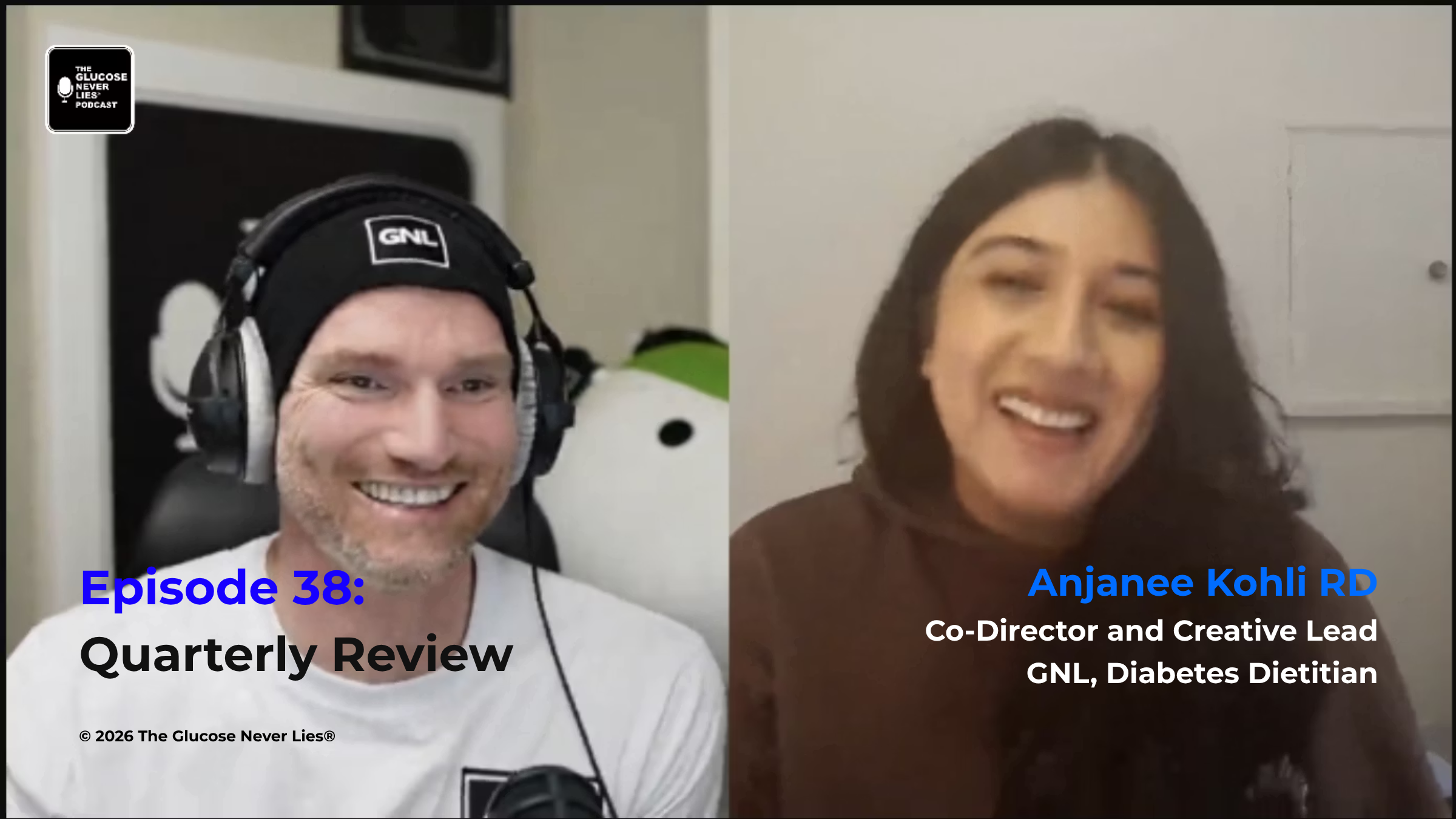
Available on Buzzsprout, Apple Podcasts, and Spotify. Host: John Pemberton. Director of Creativity: Anjanee Kohli.
Why this episode exists
The first quarter of 2026 was the most substantial rebuild GNL has had since it launched. New site, new explorers, the launch of GNL Grace, and a clearer answer to the question the team has been carrying since 2019: how does evidence-grade T1D education stay free for the people who need it most. This episode is the version where the founders sit and explain the choices, plainly, before the next quarter starts.
The episode also covers the things that did not go to plan, the moments where good ideas turned out to be ill-suited, and the small list of things that were quietly removed when they stopped working. The point of a quarterly review is not the highlights reel. The point is what was learned, and what is being changed because of it.
In this episode
John Pemberton and Anjanee Kohli, Co-Director and Creative Lead, take the conversation through the Q1 rebuild. The site rebuild and what the editorial cards changed. The six GNL Explorers and how clinicians are using them in real conversations. The launch of GNL Grace and the bounded design choices behind it. The pay-it-forward model that funds the free promise.
The episode is also where the figures behind GNL Grace’s evidence base are stated, plainly. The GNL-assessed cohort is approximately 1,300 individuals representing approximately 500,000 patient-days, drawn from an upstream Syntactiq Dynamics dataset of over 10,000 individuals and 1.5 million patient-days. The two are different. Saying so cleanly is part of the job.
Episode chapters
- 00:00, Introduction
- 01:55, GNL Grace, the announcement
- 02:32, CGM guide update and the five-out-of-five accuracy chart
- 05:30, Phillip Hayes joining as Technical Director, and the explorer infrastructure
- 09:40, GNL Grace, the bounded design choices
- 10:50, Grace tiers and the pay-it-forward model
- 13:31, Grace Max, manuscript-grade output for research and deep work
- 17:31, The evidence base, cohort figures stated plainly
- 19:58, The skill of the future in healthcare is compassion
- 30:09, What did not go to plan, and what changed
- 35:06, GNL merch
- 36:10, Closing
Watch or listen
Key themes
The site rebuild was a findability problem, not a content problem
The pre-Q1 site had years of careful writing locked behind a navigation that asked the reader to know what they were looking for before they could find it. The rebuild took the editorial cards from the CGM Series, generalised them, and applied them across every flagship surface. Most of the change in time-on-page across Q1 is the same content, presented in a layout that signals what is on the page within the first eye-track.
The Explorers do one thing each, and do it visibly
The GNL Explorers (Hypo and Hyperglycaemia, Activity and Exercise, Exercise IOB, Exercise Planning, AID Algorithm, Alcohol and T1D) are not personalised tools. They are population-average educational tools, with the framing carried in plain text at the top of every result. The six-explorer set is the version that survived a round of cuts; earlier drafts had eight. Where clinicians are using them is the validation that decided what stayed.
GNL Grace is bounded by design
Grace runs on a curated evidence base, not on a general internet. The boundary is the value: a clinician or a person with T1D opens Grace and gets a response that draws from peer-reviewed literature, clinical guidelines, and the GNL evidence packs, with the caveats and uncertainty named honestly. The design choices that bound her, the wiki backbone, the citation rules, the refusal behaviours, take longer to build than a generic chatbot and are the reason she is worth using.
The cohort figures, stated plainly
The GNL-assessed cohort is approximately 1,300 individuals representing approximately 500,000 patient-days, drawn from an upstream Syntactiq Dynamics dataset of over 10,000 individuals and 1.5 million patient-days collected between 2013 and 2025. The two figures describe two different things: the assessed cohort and the upstream pool. The phrasing on every public surface follows the locked policy at cohort-figures-canon, because the difference matters for how the evidence is interpreted.
The pay-it-forward model that funds free Grace
Grace is free to try for everyone with type 1 diabetes, then GBP 5 a month or GBP 50 a year, with sponsored free accounts for the people who cannot pay. The money to keep that promise comes from personal subscriptions, paid HCP licences, and sponsorship at Buy Me a Coffee, where every GBP 5 opens one free account, up to GBP 50 for ten. Skin in the game, from people with T1D, from clinicians, from manufacturers, from charities, and from us. This is the structural answer to the question of how educational depth survives without becoming paywalled.
The Q1 lesson that travels. The work was not about adding more. The work was about removing what did not serve the reader and naming what remained more clearly. Most of the gains in the quarter came from cuts, not additions. The same principle is the one Q2 starts with.
GNL Grace, in detail
The four layers that separate a bounded clinical AI from a generic chatbot. None of these layers existed in a single tool before Q1; the Q1 work was getting them to stack cleanly.
Phillip Hayes, GNL’s Technical Director, built the retrieval and routing in May 2026. The RAG layer pulls from 880 pages of curated content across 7,349 typed chunks, routed by document metadata so the right policy reaches the right question. The whole thing is open-sourced as a wiki anyone can read.
The six Explorers
Each Explorer does one job and does it visibly. None are personalised; all six surface population-average outputs with the framing built into the result. The set shipped at six after a round of cuts from eight.
Hypo and Hyperglycaemia Explorer
Two-tab tool. The hypo tab routes by glucose band and weight (paediatric 0.3 g/kg per ISPAD; adult 15 g per ADA; 60 kg carb cap on weight-based exercise top-up only). The hyper tab routes by glucose, ketones, time since last bolus, and AID status. Paediatric high ketones (1.5 to 2.9 mmol/L) routes through ISPAD Ch13 sick-day, not DAFNE / BERTIE adult.
Activity and Exercise Explorer
Estimates glucose-lowering effect per minute of activity by exercise type (aerobic, mixed, anaerobic) and intensity. Scaling derived from population-level U/kg exposure data: 0.025 to 0.20 mmol/L per minute depending on load. Recent bolus dosing history (last 8 hours) and trend modifier applied.
Exercise IOB Explorer, 30 Minutes
Carbohydrate estimate for a 30-minute session based on real insulin on board, body weight, exercise type, and current trend. IOB drives hypoglycaemia risk during activity; this is the most invisible factor, made visible. Population-average requirements, never individual prescriptions.
Exercise Planning Explorer, Before, During and After
Phase-by-phase planner for a planned session. Pre-activity carbohydrate by glucose band, in-session CGM check intervals, post-activity basal reduction for AID systems (90-minute pre-activation supported). Specific guidance for what “low” and “high” mean in-session for each therapy type.
AID Algorithm Explorer
Five-level algorithm-strength ladder, reviewed with input from CamAPS, MiniMed, Tandem, and Insulet medical leads. The ladder is a Grade D educational synthesis on a Grade A/B evidence base, with declared bias toward IOB visibility and the IOB-vs-algorithm-strength trade-off. Reviewed-by, never endorsed-by or validated-by.
Alcohol and T1D Explorer
Adults 18+ only by design. Maps the hepatic glucose suppression window (around one hour per unit consumed) across the drinking period and the overnight hours that follow. Carb-containing drinks cause an initial rise then a delayed fall. System-specific harm-reduction strategies for MDI, pump, and AID users.
How free Grace stays free, the pay-it-forward model
Three inbound routes fund the platform: personal subscriptions, HCP licences, and sponsorship at Buy Me a Coffee. Every GBP 5 of sponsorship opens one free account, up to GBP 50 for ten. The free seat for people who cannot pay is structural, not aspirational.
Skin in the game, all the way along. The pay-it-forward model means people with T1D who cannot pay do not have to ask for the free seat; the seat exists because someone, somewhere, paid for the licence or pressed the sponsor button. The model is the structural answer to the “how do you keep it open” question, before the question gets asked.
Practical exploration
For people living with type 1 diabetes and their families
The fastest way to know whether the rebuild lands for you is to use it.
- Try Grace on a question you already have a view on; see whether her answer surfaces the nuance you would expect.
- Walk through one of the six explorers; the framing block at the top is part of the result, not a disclaimer to skip.
- If you have an opinion on what is missing, write in. The roadmap for Q2 is genuinely shaped by what readers ask for.
For clinicians and educators
If you have been waiting to recommend a free educational tool to people you support, this is the version of GNL to point them at.
- Grace is intended to complement, not replace, the conversations you have in clinic. The handover language matters; she defers explicitly to the care team for individualised decisions.
- The DSN Forum CGM chart, the cohort canon, and the explorer framing are all explicitly cited in Grace’s responses where relevant; the references are the audit trail for anyone curious about where her answers come from.
- If you are interested in an HCP licence (GBP 20 a month or GBP 200 a year per clinician), the route is the single inbox: john@theglucoseneverlies.com.
About this episode
John Pemberton is a paediatric Diabetes Dietitian at Birmingham Women’s and Children’s NHS Foundation Trust, GNL’s founder and director, and lives with T1D himself. Anjanee Kohli is GNL’s Co-Director and Creative Lead, and a Specialist Diabetes Dietitian. Phillip Hayes, GNL’s Technical Director, is the engineering lead on the rebuilt platform and Grace.
Related reading on GNL
Episode 38 of the GNL Podcast
Q1 2026 Quarterly Review
This content is for educational exploration only. It describes average responses and general principles. It is not medical advice and cannot replace individual clinical guidance from your diabetes care team.