
The GNL Podcast, CGM Series
Episode 37, Dexcom G7 and ONE+
A school nurse silences the high-glucose alert mid-sentence. The child is fine, the spike is post-snack, and the alarm fired because the threshold has not been tuned in two years. The Dexcom G7 has the controls to handle exactly that moment, and the conversation about whether they are switched on rarely happens in a busy clinic.
Ask Grace
Want to know whether the Dexcom G7’s Delay 1st Alert is right for your family, or how its AID integrations stack up before your next pump conversation?
Part of the GNL CGM Series, a deep dive into the evidence behind CGM accuracy, study design, and device performance. Ep 35, Prof Othmar Moser on study design · Ep 36, DSN Forum reality checks · CGM Series hub
Listen
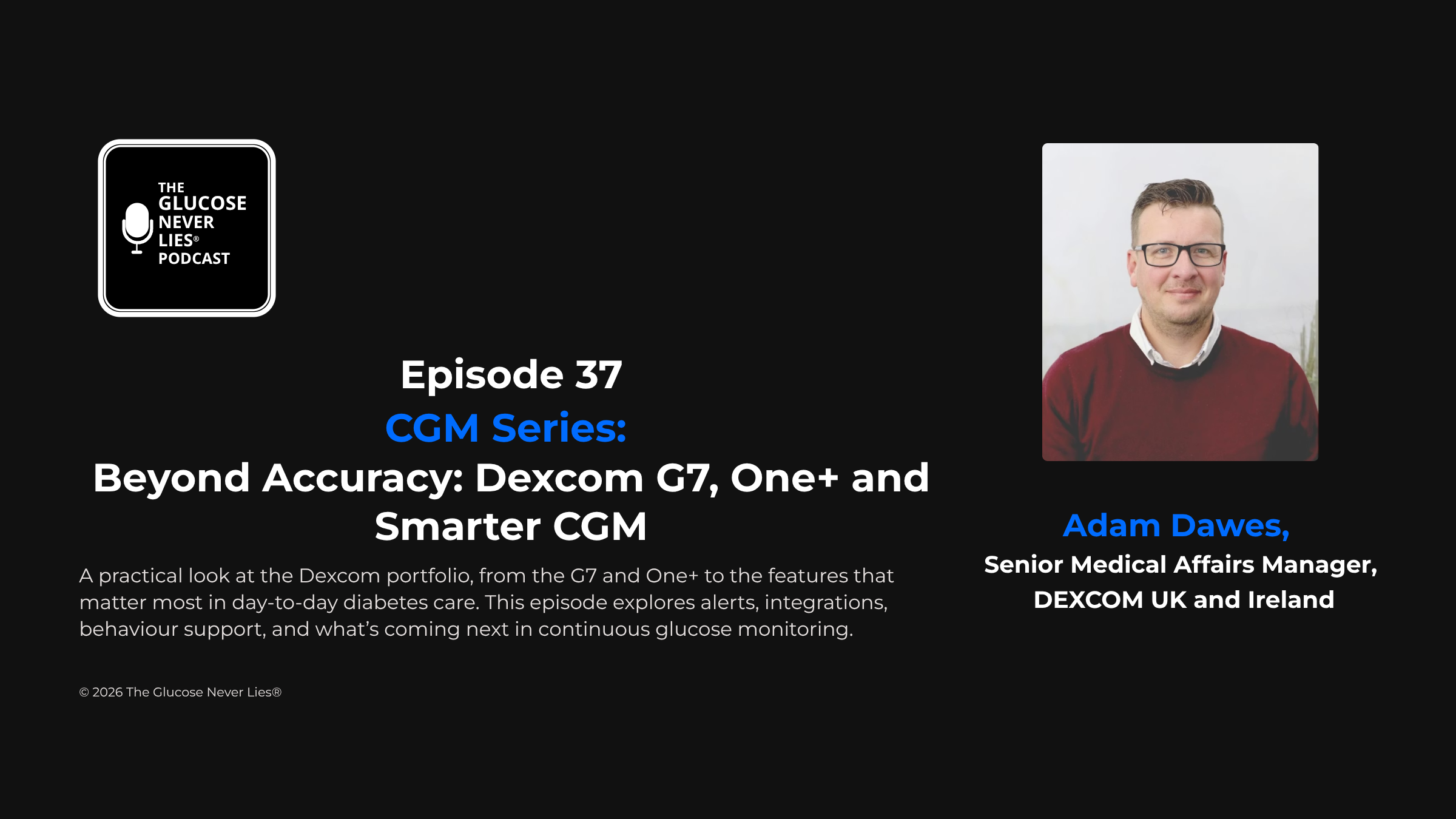
Available on Buzzsprout, Apple Podcasts, and Spotify. Guest: Adam Dawes, Senior Medical Affairs Manager, Dexcom UK and Ireland. Host: John Pemberton. Director of Creativity: Anjanee Kohli.
Why this episode exists
Anyone who has lived with a Dexcom sensor for a few months has a relationship with it that is not in the brochure. The alarm that fires every time food arrives. The reading at 5am that turns out to be the sensor pulling away from the skin. The day at school when the phone left in the bag misses three hours of data. The Dexcom G7 has had four years of algorithm updates since its UK launch; the sensor on the wrist today is a different proposition to the one many people first tried.
This episode exists for two reasons. First, to walk through what is genuinely different about the Dexcom G7 and ONE+: same hardware, different software, different patient profile. Second, to address a quieter point that does not get said often enough: insulin dosing on CGM is not a commodities market, and the choice of sensor matters in ways the price tag does not capture.
In this episode
Adam Dawes joins John having previously hosted John on Dexcom’s own podcast, so this time the tables are turned. Adam brings a perspective most medical affairs roles cannot: he trained and worked as a paediatric diabetes nurse specialist before joining Dexcom, and he has been in post long enough to watch the Dexcom G7 launch in the UK, navigate the early issues, and see the product land in a different place four years on.
The conversation walks through the Dexcom G7 and ONE+ in practical terms, what they share, where they diverge, and which people belong on which, before opening into the wider Dexcom roadmap, the role of CGM in type 2 diabetes, the FDA manufacturing story, and a candid discussion about why the CGM market will never be a true commodity market for people making insulin decisions.
Episode chapters
- 00:00, Introduction, the CGM Series and why Dexcom is next
- 00:53, Adam Dawes, from paediatric DSN to Dexcom UK Medical Affairs
- 03:18, Why John’s unit runs 280 of 300 children on Dexcom
- 05:52, Dexcom G7 features, urgent low soon and the predictive alert evidence base
- 08:28, Delay 1st Alert, the most underused alert in CGM
- 14:51, AID integrations, Tandem T:slim X2, Omnipod 5, and what is coming
- 17:28, Form factor, 30-minute warmup, 12-hour grace period
- 20:31, Dexcom ONE+, same hardware, different patient profile
- 22:07, CGM for type 2 diabetes, the biofeedback argument
- 26:32, Stelo, over-the-counter CGM, and personalised insights
- 29:22, Clarity moving in-app, data ownership simplified
- 30:42, ATTD roadmap, 15-day sensor, G8, EPIC integration
- 43:45, Why insulin dosing is not a commodity market
- 47:15, FDA manufacturing, the response, and the Ireland factory
- 51:52, Closing, measuring organisations by how they respond when things go wrong
Watch or listen
Key themes
Same hardware, different software
The Dexcom G7 and ONE+ are built on identical hardware: the same sensor filament, the same transmitter, the same all-in-one form factor. The difference is software and patient profile. The Dexcom G7 retains urgent low soon and Delay 1st Alert and carries the full AID integration stack. The ONE+ removes urgent low soon, appropriate for people without significant hypoglycaemia risk, and simplifies the experience for primary care, type 2 insulin users, and MDI users who do not need the full alarm architecture. Knowing the distinction is the difference between matching a device to a person and defaulting one product to everyone.
Delay 1st Alert, alarm design that reduces harm
Alarm fatigue is one of the least-discussed harms in CGM use, and it is real. When high alerts fire every time a meal arrives, people switch them off or set the threshold so high it stops being useful. Delay 1st Alert solves this by only alerting once glucose has been above a set threshold for a defined period (typically two hours), by which point the alert is actionable: it is time to check ketones, take a correction, consider changing a set, or get moving. For paediatric settings the impact is concrete: it removes the alarm that announces diabetes during a school lesson without giving the child anything to do about it.
AID integration, the Dexcom G7 as a platform
The Dexcom G7 integrates with Tandem T:slim X2 and Omnipod 5 in the UK, with mylife integration announced for piloting in other markets, and Tandem Mobi on the horizon. That makes it the widest AID integration stack available here. Integration is not just compatibility; it carries interoperability obligations. Every firmware update across the stack requires re-validation, which is why new sensors, algorithms, and pumps take time to reach people even once the underlying technology is ready. The 15-day Dexcom G7 will need separate validation for each connected AID system before it can be used in those configurations.
CGM in type 2 diabetes, the biofeedback argument
The evidence base for CGM in type 2 diabetes has shifted from a trickle to a wave in the last five to ten years. The mechanism is less about alarm thresholds and more about immediate feedback. For someone managing type 2 through lifestyle, diet, and possibly basal insulin, the CGM offers something no three-monthly HbA1c can: a direct, visible link between a choice and a glucose outcome within hours. John describes it as biofeedback with a biological foundation: when an evening carbohydrate reduction shows up as a flatter overnight line, motivation is sustained in a way abstract future outcomes cannot achieve.
The 15-day sensor and the G8, what is actually changing
The 15-day Dexcom G7 in the US is not simply the same sensor with a longer lifespan. The extension comes alongside an algorithm update Dexcom is limited in describing publicly because of regulatory constraints. What Adam confirms: the change is algorithm-driven, not hardware-driven, meaning the filament and transmission hardware are the same. The G8, by contrast, is a full platform generation: a redesigned filament, the possibility of additional analytes (ketones are discussed; John advocates for lactate as a more meaningful exercise and pre-diabetes signal), and a smaller on-body footprint. Both are coming to Europe, with adults-first in the US meaning paediatric studies are likely running concurrently.
Why insulin dosing is not a commodities market
As more CGM manufacturers compete on price, there is structural pressure towards treating CGM readings as interchangeable. John’s counter is precise: for anyone making insulin decisions on CGM data, the 40/40 threshold (the maximum acceptable error band for iCGM-approved sensors) defines the floor, not the ceiling. A reading that sits outside that band on 1% of occasions will, over a sensor lifetime, produce incorrect insulin doses. The analysis is different for non-insulin CGM users (behaviour change, lifestyle, pre-diabetes), where occasional inaccuracy carries different consequences. For type 1 and insulin-using type 2, device quality is a safety question, not a cost question.
The Dexcom G7 in 2026 is not the Dexcom G7 in 2022. The UK and Ireland were the first markets to launch the Dexcom G7, and being first came with risk. Early performance issues led John’s paediatric centre to pause migration from G6 and restart it in January 2026. For anyone who tried the Dexcom G7 early and moved back, the sensor available today has been through several algorithm updates and is a different proposition.
The Dexcom G7, in detail
The figures, the AID compatibility matrix, and the practical features condensed into the form the episode references throughout. Source: the GNL Dexcom G7 device guide, audited against Garg 2022 (adults) and Laffel 2022 (paediatrics).
One sensor, three AID systems. The G7 is the only CGM currently approved for use with Omnipod 5, Tandem t:slim X2 with Control-IQ, and CamAPS FX, the three patient-led AID systems on the UK market. The MiniMed 780G runs on its own three-sensor ecosystem and does not pair with the G7.
Alarms and alerts
Customisable high and low alerts, urgent-low alert, rapidly-falling alert. The 12-hour grace period at end-of-life means no end-of-sensor alarm until the grace window expires, less interruption in the school morning and the meeting that runs over.
Follow and Share
The Dexcom Follow app lets family, carers, and school staff see real-time glucose data. Particularly valued in paediatric use and in the transition to independent young adulthood. John’s view: surveillance beyond five active followers usually stops being useful for the person wearing the sensor.
All-in-one design
Unlike the G6, the G7 has no separate transmitter clip. The transmitter sits inside the disposable sensor pod, fewer parts to manage, fewer things to lose, a flatter profile against the upper arm.
Optional calibration
Factory-calibrated by default, but accepts an optional calibration entry if someone wants one. Any calibration entered should come from a properly performed finger-prick reading, never from another CGM.
Receiver option
A standalone Dexcom receiver is available for anyone who prefers not to use a smartphone, including settings (work, school, restricted environments) where personal phone use is not allowed.
Practical exploration
For people living with type 1 diabetes and their families
The settings that affect daily life most are usually the ones easiest to forget about.
- If you wear the Dexcom G7, look at the Delay 1st Alert setting. It removes the alarm that fires after meals when there is nothing actionable to do.
- If you have 10 or more followers on your CGM, ask whether all of them are necessary. John’s clinical view is that surveillance beyond five is usually unhelpful for the person wearing the sensor.
- If you tried the Dexcom G7 early and went back to the G6, it may be worth revisiting. The sensor has had several algorithm updates since launch.
- Use the 12-hour grace period to schedule sensor changes outside the morning school rush, so a fresh sensor does not sit in warmup just as it is needed.
- All sensors, including the most accurate, will occasionally read outside the 40/40 error band. A working finger-prick meter remains part of the kit.
For clinicians and educators
The questions worth raising at the start of a Dexcom G7 conversation are not the headline figures; they are the settings that decide whether the sensor is doing its job.
- Treat Delay 1st Alert as part of the setup conversation when moving people from G6, not as an optional extra.
- Match Dexcom G7 versus ONE+ to risk profile, not accuracy need. The hardware is identical; the alarm architecture is what changes.
- If your centre runs EPIC, explore the Dexcom Clarity EPIC integration. It removes the multi-tab clinic workflow and creates a matched CGM and HbA1c dataset for audit and research.
- For people with type 2 diabetes on insulin where behaviour change is the primary goal, the biofeedback evidence base is substantial. CGM provides immediate feedback that retrospective clinic reviews cannot replicate.
- When discussing CGM choice, be explicit about what iCGM approval means, what the 40/40 threshold represents, and why insulin dosing requires that accuracy standard.
About the guest
Adam Dawes is Senior Medical Affairs Manager for Dexcom UK and Ireland. Before joining industry, Adam trained and worked as a paediatric diabetes nurse specialist in London and at Cambridge’s Addenbrooke’s Hospital. He joined Dexcom over four years ago and leads medical education and evidence dissemination across UK and Ireland, including the expansion of CGM access into primary care and type 2 diabetes. His clinical background gives him an unusual vantage point in medical affairs: he has prescribed and supported the devices he now works on, and he has worked with the families and school teams whose daily experience of CGM the product decisions ultimately affect.
Related reading on GNL
Episode 37 of the GNL Podcast
Dexcom G7 and ONE+
This content is for educational exploration only. It describes average responses and general principles. It is not medical advice and cannot replace individual clinical guidance from your diabetes care team.