
The GNL Podcast
Episode 31, Pregnancy with Type 1 Diabetes
The morning of the pre-conception clinic appointment. The folic acid box on the shelf, the CGM still showing the night that just ran high, the running list in your head of every glucose question you have not had answered yet. The pathway you are joining is materially better than the one your mother might have walked; the version that has matured in the last eight years is real, and the team that runs it is reachable.
Ask Grace
Want to know what the AiDAPT and CONCEPTT evidence actually says about hybrid closed-loop and CGM in pregnancy, and the right questions for the pre-conception clinic?
Listen
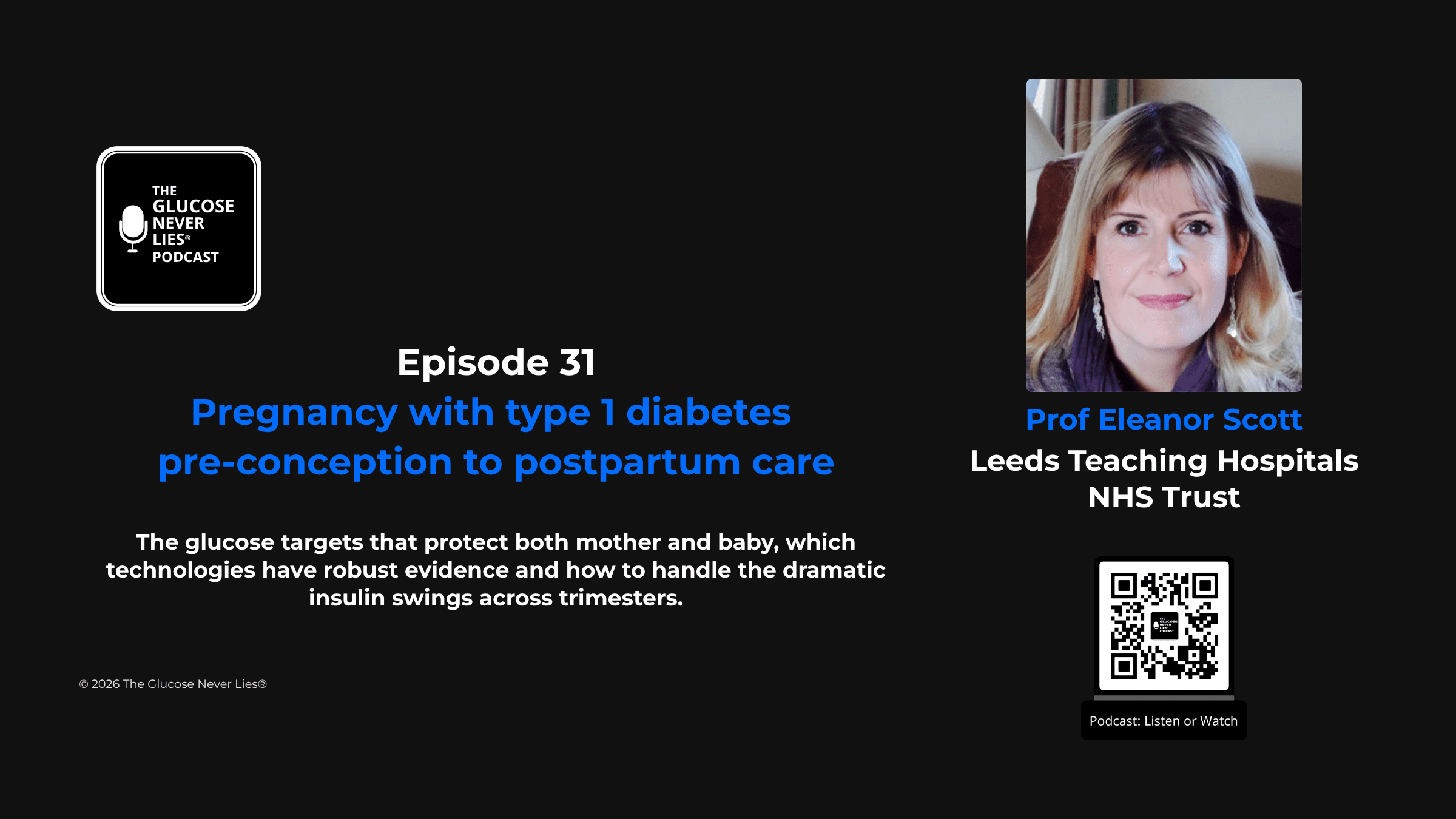
Available on Buzzsprout, Apple Podcasts, and Spotify. Guest: Professor Eleanor Scott (Leeds Teaching Hospitals NHS Trust), one of the UK’s leading clinical researchers in pregnancy and diabetes. Host: John Pemberton. Director of Creativity: Anjanee Kohli.
Why this episode exists
For decades, pregnancy with type 1 diabetes carried a level of anxiety that the contemporary pathway has begun to dismantle. Tight glucose targets, daily noticing, an overwhelming amount of clinical information delivered at the worst possible time; the experience has not changed. What has changed is the evidence underneath it. CGM in pregnancy and hybrid closed-loop in pregnancy each landed in the last eight years in a way that materially shifted what good antenatal care looks like.
Professor Eleanor Scott led the AiDAPT trial of CamAPS FX in pregnancy (Lee 2023, NEJM), the evidence base that anchors the December 2020 NICE NG3 update and the contemporary case for hybrid closed-loop in T1D pregnancy. The episode is a practical walk-through of that pathway, pre-conception to postpartum, the version that the version of the UK NHS Eleanor works in now offers.
In this episode
John and Professor Scott walk through the pre-conception window, the trimester-by-trimester insulin trajectory, where CGM and pregnancy-specific hybrid closed-loop have landed in NHS practice, and what the UK National Pregnancy in Diabetes Audit tells us about real-world outcomes. They also cover the practical strategies that hold up across pregnancies, the conversations that work in clinic, and the postpartum and breastfeeding insulin reset that catches teams out when it is not planned for.
The frame throughout is honest about what the evidence supports and where it does not yet stretch. Pregnancy in T1D is a specialist pathway; everything below is educational context for the conversations with your antenatal and diabetes team.
Episode chapters
- 00:00, Introduction and the pre-conception window
- 04:30, NICE NG3 targets and the HbA1c conversation
- 09:15, First trimester, sensitivity and the variability myth
- 15:40, Second and third trimesters, insulin resistance and progressive adjustment
- 23:00, AiDAPT and CONCEPTT, the evidence that changed NICE
- 30:45, CamAPS FX and the NHS England switching fund
- 37:20, Labour, the JBDS-IP 12 standard, VRIII and continuing pump and CGM
- 43:10, Postpartum, the insulin reset and breastfeeding
- 48:55, Ketones in pregnancy, the lower threshold
- 53:30, John’s takeaways and close
Watch or listen
Key themes
Pre-conception is where the pathway begins
The pre-conception target in NICE NG3 (Diabetes in pregnancy, last updated December 2020) is HbA1c below 6.5 per cent (48 mmol/mol) where achievable without problematic hypoglycaemia, with 5 mg folic acid daily from pre-conception to twelve weeks. The HbA1c target is tighter than the non-pregnancy target for a reason; the structured pre-conception clinics that exist in most UK regions are the place where the run-up to conception is supported. If you are using AID before pregnancy, you can carry it into pregnancy.
The first trimester is variability, not failure
The first twelve weeks bring increased insulin sensitivity, frequent lows, nausea that complicates bolusing, and highly variable glucose levels. Many women describe doing everything right and still seeing the data swing widely; this is normal physiology, not failure. Bolusing after meals rather than before is the option most aligned with vomiting risk; this is a conversation to have with your team. Pregnancy-specific hybrid closed-loop handles this variability far better than manual adjustments do.
Second and third trimesters, the resistance climb
Insulin needs climb dramatically, driven by placental hormones. Insulin-to-carb ratios can move from 1:10 to 1:3 or even 1:2, and basal rates and bolus doses need progressive weekly adjustment. This is physiology, not a sign of poor control. Pre-bolusing 15 to 20 minutes before meals becomes particularly important, even on hybrid closed-loop, because insulin acts more slowly relative to carbohydrate absorption in the resistant state.
CGM is now standard care
The CONCEPTT trial (Feig 2017, Lancet) showed that real-time CGM in pregnancy improved HbA1c modestly and reduced large-for-gestational-age babies, neonatal hypoglycaemia, NICU admission longer than 24 hours, and neonatal hospital stay. NICE NG3 recommends real-time CGM for all pregnant women with T1D on the strength of that trial. Real-world NHS data confirms the benefits, and CGM saves NHS resources compared with fingerprick testing alone.
AiDAPT and the case for hybrid closed-loop in pregnancy
Not all hybrid closed-loop systems are equal in pregnancy. AiDAPT (Lee 2023, NEJM, multicentre RCT of CamAPS FX across nine UK NHS sites, 124 pregnant women) showed pregnancy time-in-range improved by 10.5 percentage points versus standard care, equivalent to roughly 2.5 additional hours per day in the pregnancy target range, with reduced gestational weight gain, lower large-for-gestational-age, reduced neonatal hypoglycaemia, and less maternal burden. CamAPS FX has an adaptive algorithm that prioritises recent glucose data over historical patterns, which matters in the rapidly changing physiology of pregnancy. CRISTAL (Benhalima 2024, MiniMed 780G in pregnancy) is the next pivotal trial in the same space.
The NHS England switching fund
NHS England has created a switching fund that allows women to temporarily switch to CamAPS FX for pregnancy, even if they use a different system outside pregnancy. The fund is the operational route the AiDAPT evidence has opened, and it sits inside the antenatal pathway your specialist team manages.
Pregnancy-specific glycaemic targets are tighter, and HAPO is the why
The pregnancy-specific targets in NICE NG3 are fasting below 5.3 mmol/L (95 mg/dL), one-hour postprandial below 7.8 mmol/L (140 mg/dL), two-hour postprandial below 6.4 mmol/L (115 mg/dL), avoiding hypoglycaemia below 4 mmol/L (72 mg/dL). The continuous risk gradient between maternal hyperglycaemia and adverse perinatal outcome at glucose levels well below the conventional diabetes diagnostic threshold was established by the HAPO study (2008, NEJM); HAPO is the reason pregnancy targets are tighter. Aspirin 75 to 150 mg daily from twelve weeks until birth reduces pre-eclampsia risk in women with T1D; this is the specialist team’s prescribing decision.
Labour, the UK standard and what continues
The UK operational standard during established labour is a maternal capillary plasma glucose target of 4 to 7 mmol/L (72 to 126 mg/dL), per JBDS-IP 12 (February 2023). Variable-rate intravenous insulin infusion is recommended for women with T1D in established labour, or for any woman with diabetes whose oral intake is restricted or whose glucose drifts above target. Continuation of pump and CGM during labour is permitted where the woman wishes it and the unit is competent. After delivery, insulin requirements drop sharply; immediate dose review is required.
Postpartum, the insulin reset
Once the baby and placenta are delivered, insulin needs return to pre-pregnancy levels. A safe starting point is reducing basal insulin by around 50 per cent and returning carb ratios to pre-pregnancy levels, with the team reviewing within 24 hours and adjusting from there. Breastfeeding uses meaningful energy and may reduce insulin requirements further; having snacks readily available during feeds tends to prevent lows. The reset is the conversation the diabetes team holds with you, not a fixed protocol.
Ketones in pregnancy, the lower threshold
Diabetic ketoacidosis can develop faster in pregnancy. If glucose is persistently high (above 14 mmol/L (252 mg/dL) for 90 minutes) despite insulin corrections, check for pump and cannula issues and check ketones. The threshold for medical advice in pregnancy is meaningfully lower than outside it; the specifics belong with your team.
One high glucose is not catastrophic
What matters is time in range averaged across days and weeks of pregnancy, not perfection every hour. Reframing CGM data as information rather than judgement, what happened, what is the likely driver, what is one tweak for next time, reduces the paralysis that comes from fear of imperfection. This is one of the conversations Eleanor returns to most often in clinic.
The pathway has materially improved; the team is the route. The evidence base for CGM and hybrid closed-loop in T1D pregnancy has matured to the point where the contemporary antenatal pathway is materially better than the one your mother walked. The first conversation is with your diabetes team. If you are planning, ask for the pre-conception clinic referral. If you are pregnant now, ask for the joint diabetes-and-obstetric referral and for CGM if you are not already on one. Bring your data, ask early, ask in writing if the first answer is delayed.
Evidence backbone
Site delivery is voice-first; the underlying source layer is research-grade and lives in the GNL Grace wiki. Tap any source for the citation detail.
Lee 2023, AiDAPT (CamAPS FX in pregnancy)
Lee TTM et al. Automated Insulin Delivery in Pregnancy Complicated by Type 1 Diabetes. NEJM 389(17):1566-1578. doi:10.1056/NEJMoa2303911. Multicentre RCT of CamAPS FX, nine UK NHS sites, 124 pregnant women. Pregnancy time-in-range improved by 10.5 percentage points versus standard care, with reductions in gestational weight gain, large-for-gestational-age, neonatal hypoglycaemia, and maternal burden.
Feig 2017, CONCEPTT (real-time CGM in pregnancy)
Feig DS et al. Continuous Glucose Monitoring in Pregnant Women with Type 1 Diabetes (CONCEPTT). Lancet 390(10110):2347-2359. doi:10.1016/S0140-6736(17)32400-5. Real-time CGM in pregnancy improved HbA1c modestly and reduced large-for-gestational-age, neonatal hypoglycaemia, NICU admission longer than 24 hours, and neonatal hospital stay. The anchor for the NICE NG3 December 2020 update on real-time CGM in pregnancy.
HAPO 2008, hyperglycaemia and adverse pregnancy outcome
HAPO Study Cooperative Research Group. Hyperglycemia and Adverse Pregnancy Outcomes. NEJM 358:1991-2002. The continuous risk gradient between maternal hyperglycaemia and adverse perinatal outcome at glucose levels well below the conventional diabetes diagnostic threshold. The reason pregnancy targets are tighter than non-pregnancy targets.
Benhalima 2024, CRISTAL (MiniMed 780G in pregnancy)
Benhalima K et al. CRISTAL trial of advanced hybrid closed-loop (MiniMed 780G) in pregnancy complicated by T1D. The next pivotal trial in the AID-in-pregnancy space, providing complementary evidence to AiDAPT for a different algorithm family.
NICE NG3, diabetes in pregnancy (updated December 2020)
NICE guideline NG3. Diabetes in pregnancy: management from preconception to the postnatal period. Updated December 2020 to recommend real-time CGM for all pregnant women with T1D, on the strength of CONCEPTT. Sets the pre-conception HbA1c target, the trimester-specific glycaemic targets, and aspirin prophylaxis for pre-eclampsia risk reduction.
JBDS-IP 12, intrapartum care (February 2023)
Joint British Diabetes Societies for Inpatient Care. Management of glycaemic control in pregnant women with diabetes on obstetric wards and delivery units. February 2023. Maternal capillary glucose target 4 to 7 mmol/L (72 to 126 mg/dL) during established labour. Variable-rate intravenous insulin infusion recommended for women with T1D in established labour. Continuation of pump and CGM permitted where the woman wishes and the unit is competent.
NPID 2023 dashboard, UK National Pregnancy in Diabetes Audit
National Pregnancy in Diabetes Audit (NHS England, NHS Digital, Diabetes UK, HQIP). 2023 dashboard covering pregnancies that ended between January 2021 and December 2023, published August 2024. The first NPID release to include CGM uptake data, reflecting the December 2020 NICE NG3 update. The UK provider-level snapshot of real-world contemporary pregnancy outcomes.
Practical exploration
For people living with T1D planning or in pregnancy
The pathway is specialist; the work you do at home in parallel makes the team conversation more specific. The list below is educational context, not protocol, and is intended to make the next appointment count.
- If you are planning pregnancy, ask your diabetes team for a pre-conception clinic referral. Start 5 mg folic acid daily (prescription) and check vitamin D. Ask about the NICE NG3 HbA1c target and how to work toward it without problematic hypoglycaemia.
- If you are pregnant now, contact the team as soon as you know. Ask for the joint diabetes-and-obstetric referral and for CGM if you are not already on one.
- If you are using AID before pregnancy, ask about the NHS England switching fund and CamAPS FX; this is the team’s decision on the AiDAPT evidence.
- In the first trimester, expect increased sensitivity and frequent lows. If nausea is making before-meal bolusing risky, the conversation with your team is about timing.
- In the second and third trimesters, expect insulin needs to climb progressively. Pre-bolusing 15 to 20 minutes before meals tends to matter more in the resistant state. Mixed meals (protein, fat, vegetables with carbohydrates) slow absorption and better match insulin action.
- Have a postpartum reset plan written with the team before delivery. Insulin needs drop sharply at delivery; further reductions are common with breastfeeding.
- One high glucose is not catastrophic. What matters is the time-in-range picture across days and weeks.
For clinicians and educators
The contemporary T1D-in-pregnancy pathway pulls on the diabetes team, the obstetric team, the inpatient team, and the structured-education curriculum at every stage. The lift below is the operational shape.
- The pre-conception clinic is the highest-leverage contact point. NICE NG3 sets the HbA1c target and the 5 mg folic acid recommendation; the team’s role is to support the run-up without problematic hypoglycaemia.
- The December 2020 NICE NG3 update recommends real-time CGM for all pregnant women with T1D on the strength of CONCEPTT; CGM uptake is now in the NPID dashboard.
- For AID users, AiDAPT is the evidence base for CamAPS FX in pregnancy. The NHS England switching fund is the operational route. CRISTAL (MiniMed 780G in pregnancy) is the next pivotal dataset.
- Trimester-specific insulin-to-carb ratios may move from 1:10 to 1:3 or 1:2 by late pregnancy; progressive weekly adjustment is the principle. The team is the route.
- The JBDS-IP 12 (February 2023) intrapartum standard sets the maternal capillary glucose target and continuation of pump and CGM during labour where competent.
- Postpartum, plan the insulin reset before delivery: basal reduced by around 50 per cent and carb ratios returned to pre-pregnancy levels is the starting point most teams use; review within 24 hours.
- The NPID 2023 dashboard is the provider-level real-world outcomes mirror for the antenatal pathway in T1D.
About the guest
Professor Eleanor Scott is a consultant physician at Leeds Teaching Hospitals NHS Trust and one of the UK’s leading clinical researchers in pregnancy and maternal health in type 1 diabetes. She leads the diabetes-in-pregnancy service at Leeds, runs a research group focused on pregnancy outcomes, and has shaped UK national and international policy on diabetes care in pregnancy. She led the AiDAPT trial of CamAPS FX in pregnancy (Lee 2023, NEJM), the evidence base that anchors the December 2020 NICE NG3 update on real-time CGM and the contemporary case for hybrid closed-loop in T1D pregnancy.
Related reading on GNL
Episode 31 of the GNL Podcast
Pregnancy with Type 1 Diabetes
This content is for educational exploration only. It describes average responses and general principles. It is not medical advice and cannot replace individual clinical guidance from your diabetes care team. Pregnancy with type 1 diabetes requires specialist medical supervision; contact your diabetes team before, during, and after pregnancy.