
CGM Guide – Part 4
Top 10 Tips to Optimise Time in Range
Practical behaviours, insulin strategies, exercise adjustments, and sensor techniques that improve glucose outcomes – grounded in evidence and real-world implementation.
Ask Grace
Want to get more out of your CGM than the number on the screen? Ask Grace.
Two foundations before the tips
Continuous Glucose Monitoring has transformed life with type 1 diabetes. Real-time data, trend arrows, alerts, and pattern recognition now make it possible to improve time in range in ways that were simply not feasible a decade ago.
But before optimisation, tips, or performance, two foundations matter more than everything that follows.
Foundation 1: blood glucose testing still matters
CGM is extraordinary – but it is not infallible.
When a CGM reading does not match symptoms, context, alarms, or common sense, accurate finger-prick blood glucose testing remains the gold-standard reference. That only works if you have an ISO-standard meter, your strips are in date, and you still know how to perform a proper finger-prick test.
As CGM use has become widespread, this skill has quietly eroded. That erosion matters most precisely in high-risk situations – alarms, unexpected readings, illness, or insulin dosing decisions – where the downside risk is asymmetric.
Foundation 2: “70% time in range” does not mean the same thing on every CGM
Not all CGM systems measure or report glucose in the same way.
Some CGMs are calibrated closer to capillary glucose, others closer to venous glucose, and some read below venous levels by design. The practical consequence is simple but widely misunderstood:
- The same headline 70% TIR can represent different true glucose exposure depending on the CGM.
- A Zone B sensor reports a time in range roughly 6 to 10 percentage points higher than a Zone P sensor for the same physiological reality.
If you do not understand how your CGM is calibrated, it is easy to misinterpret performance, chase “inaccuracy” that is actually physiology, or judge yourself unfairly.
Once those two foundations are in place – how to verify and how to interpret – optimisation finally makes sense.
10 top tips to optimise time in range
Should you follow them? I do not know. I do not know your physiology, your lifestyle, or your constraints – and I do not have skin in your game. View this as education, not instruction, and discuss changes with your diabetes care team.
Prefer a podcast? Episode 6: Ten Tips to Optimise Time in Range
Here is the quick index with timestamps from the episode:
- Food and insulin: 3 balanced meals with 10 minutes of activity after – (minutes 0 – 4)
- High fat and protein meals: “Find out before you fiddle” then 25% extra insulin increments – (minutes 4 – 10)
- After meal spikes: Insulin 15 minutes before in the abdomen or arm – (minutes 10 – 14)
- 3 every 30: 3 minutes of movement every 30 minutes sitting – (minutes 14 – 16)
- 10 by 2: 10 minutes of activity drops glucose by approximately 2 mmol/L (35 – 40 mg/dL) between meals – (minutes 16 – 22)
- 50/50/20: Exercise insulin reductions for injections and standard pump therapy – (minutes 22 – 30)
- T25/T25: Exercise insulin reductions for AID therapy – (minutes 30 – 38)
- CGM: SLO ARSE: Slow and Low, Oil, Arm, Relax, Soft, Elevate – (minutes 38 – 40)
- Site management: CAR – Change, Abdomen, Rotate – (minutes 40 – 41)
- Does your CGM change what your time in range means? (minutes 41 to 50)
Tip 1: Food and insulin
- Strategy: Three balanced meals and 10 minutes of physical activity after each meal to enhance insulin effectiveness.
- Quote: “Putting in that 10 minutes of walking after eating really makes a huge difference on the glucose levels.”
- Details: The post-meal movement helps match the timing of peak rapid-acting insulin with glucose entering the bloodstream, smoothing out spikes.
- Extra tip: Consistency in meal timing and composition can stabilise glucose and make CGM patterns much easier to interpret.
Tip 2: High fat and protein meals – “find out before you fiddle”
Francesca Annan RD
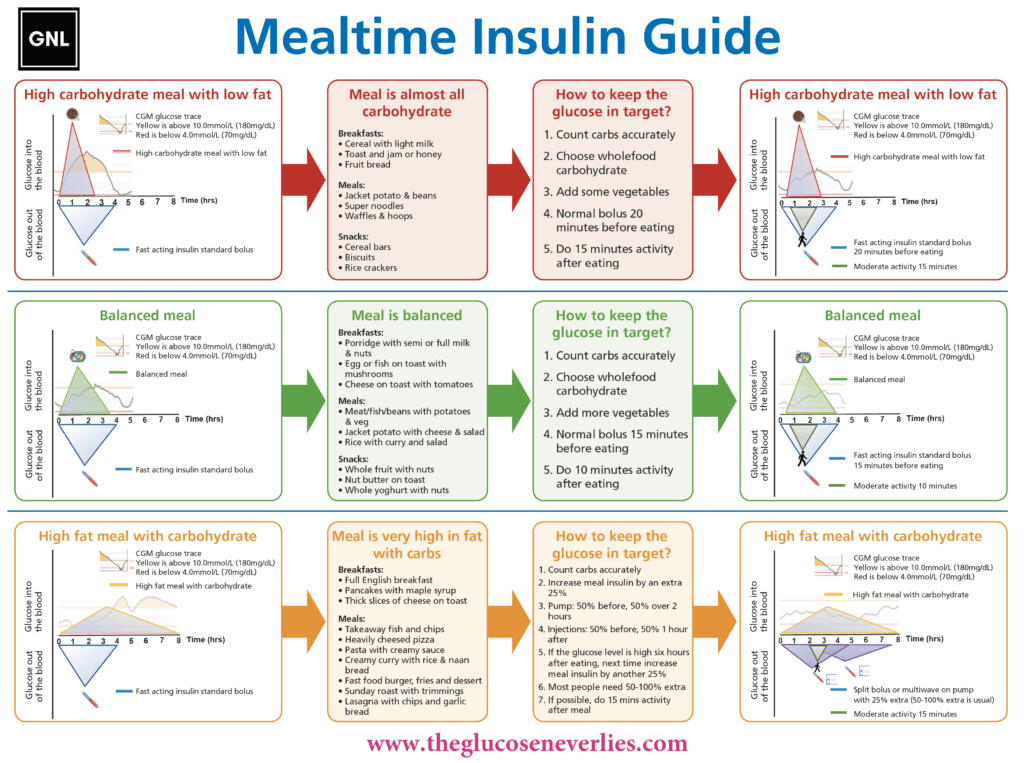
- Strategy: Adjust insulin dosing for high-fat, high-protein meals.
- Quote: “Find out before you fiddle” – and consider approximately 25% extra insulin increments if needed.
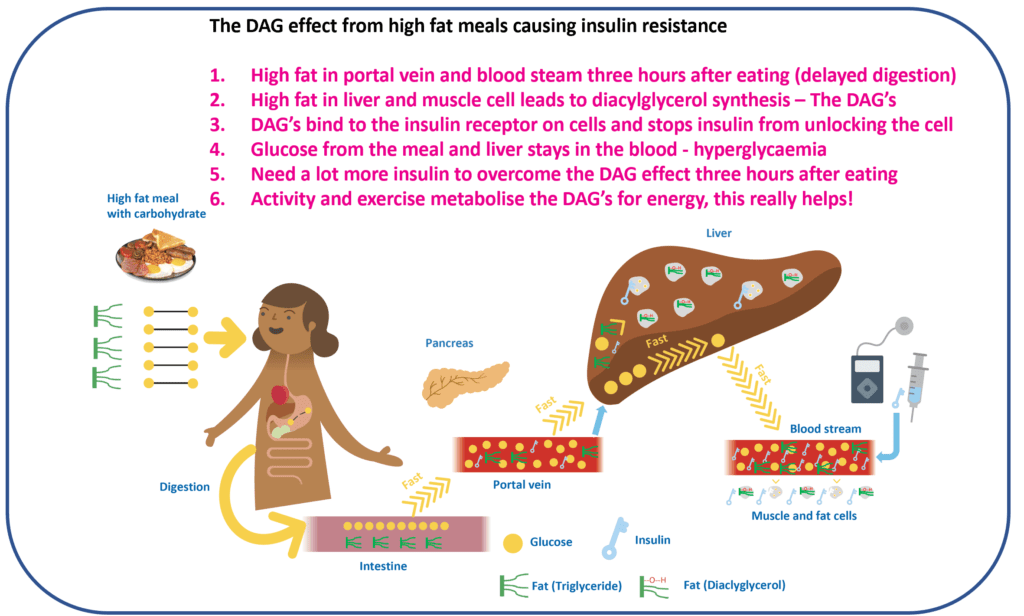
- Details: Fat delays gastric emptying and can induce insulin resistance, often requiring more insulin over a longer period.
- Extra tip: Use your CGM to learn your response. Watch the 3 – 6 hour post-meal window and build up your own pattern knowledge over multiple similar meals.
Tip 3: After-meal spikes
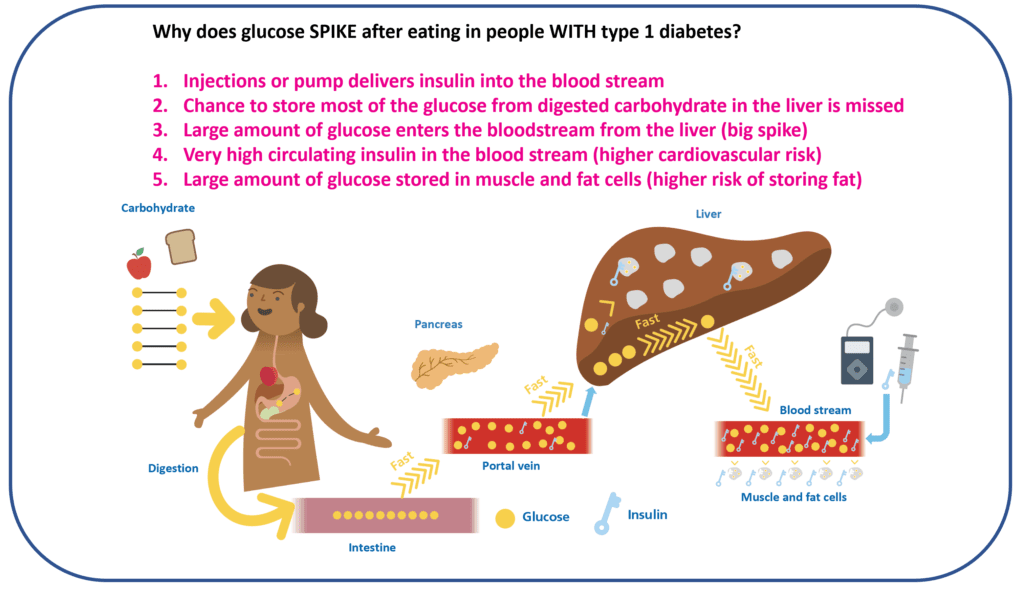
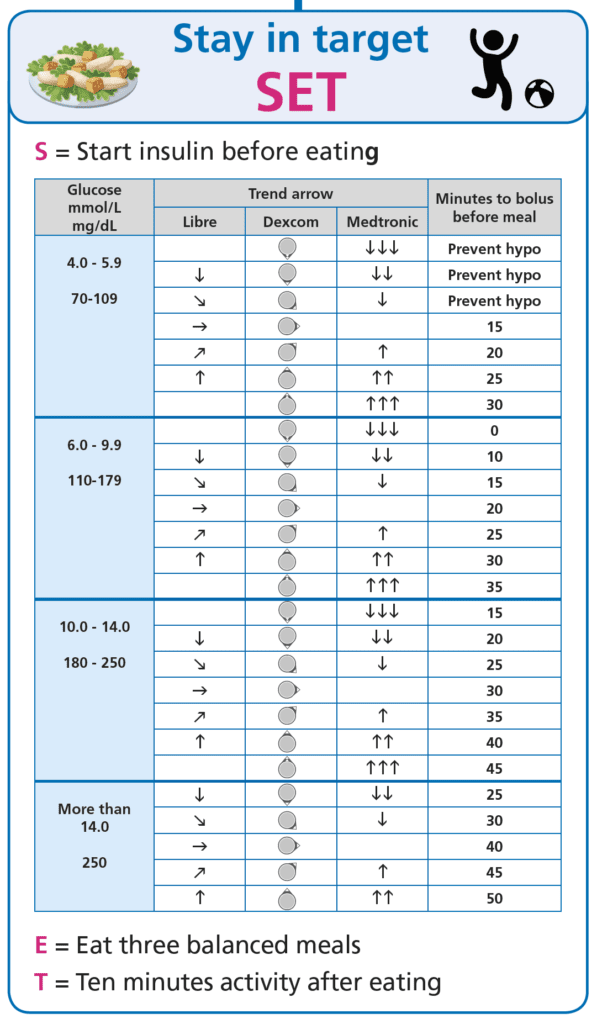
- Strategy: Take rapid-acting insulin about 15 minutes before eating to reduce post-meal spikes.
- Quote: “Where is the fastest place for absorption for your insulin? The belly… not far behind is the arm.”
- Details: Pre-bolusing and using faster-absorbing sites improve alignment between insulin action and glucose rise.
- Extra tip: Rotating injection or pump sites between abdomen and arm helps maintain good absorption over time.
Tip 4: 3 every 30
- Strategy: Take 3 minutes of light movement every 30 minutes of sitting.
- Quote: “Every 30 minutes they got up to walk around at a normal pace for three minutes… time in range improved by 14%.”
- Details: Regular breaks reduce insulin resistance and help CGM time in range without changing insulin doses.
- Extra tip: Setting phone or watch reminders is a simple way to build this into any working day. The benefit extends well beyond diabetes.
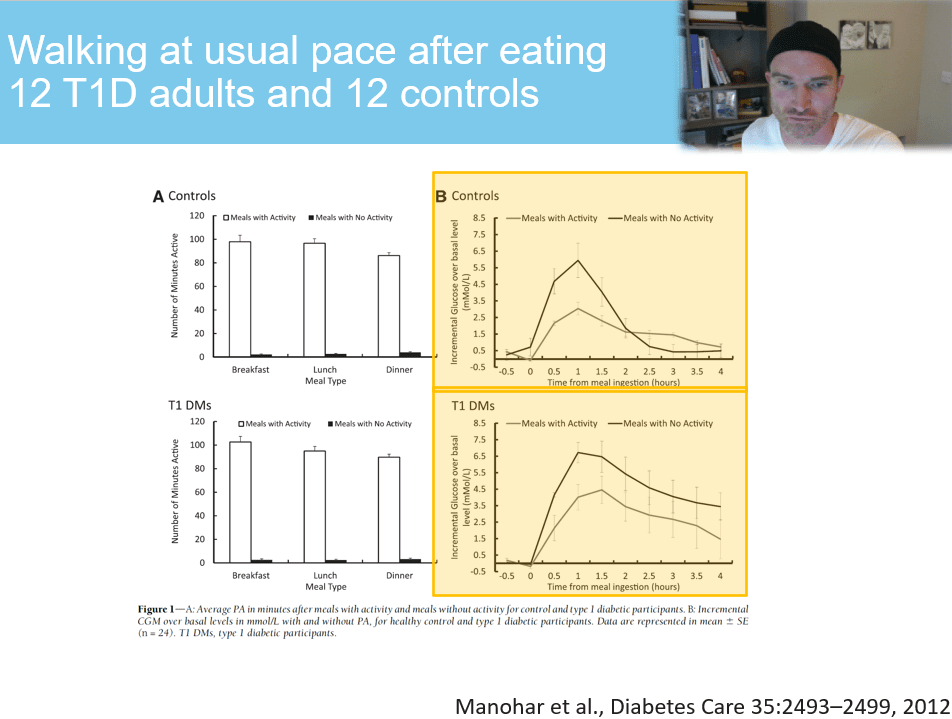
Tip 5: 10 by 2 mmol/L (or approximately 10 by 40 mg/dL)
- Strategy: Use brief activity to quickly lower glucose between meals.
- Quote: “Ten minutes will drop the glucose level by two… or 10 will drop you by about 40 milligrams per decilitre if you are in those units.”
- Details: A short walk or similar light activity can reduce mild highs without extra insulin, particularly helpful if there is still insulin on board from a recent dose.
- Extra tip: The glucose-lowering effect of activity varies with intensity, timing, and individual response – your own CGM data is the best guide to what works for you.
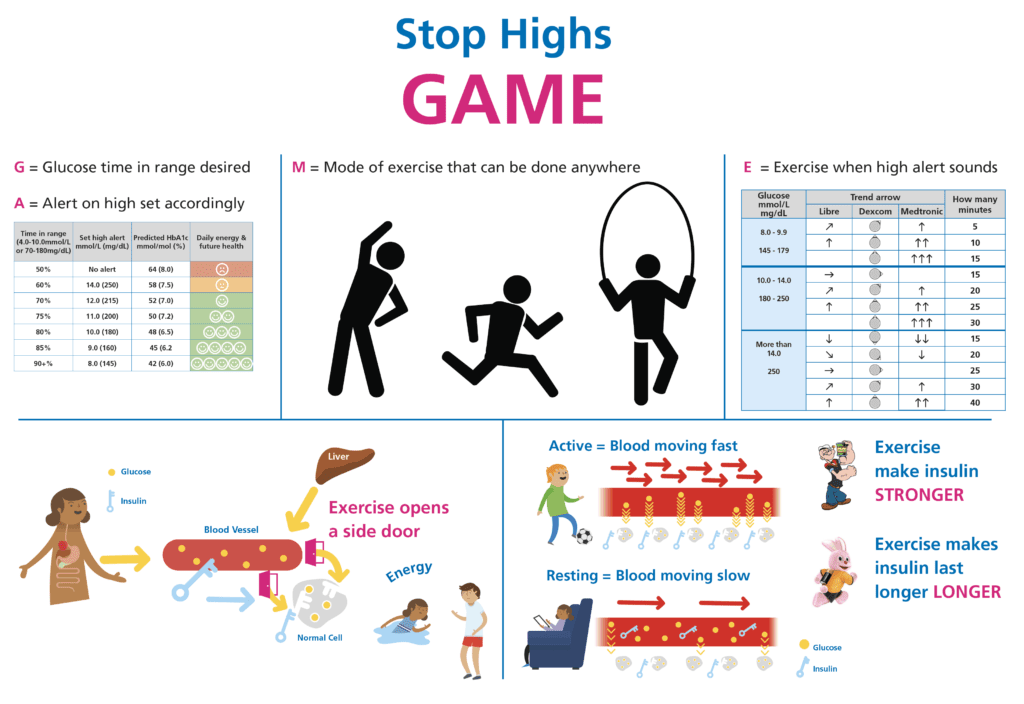
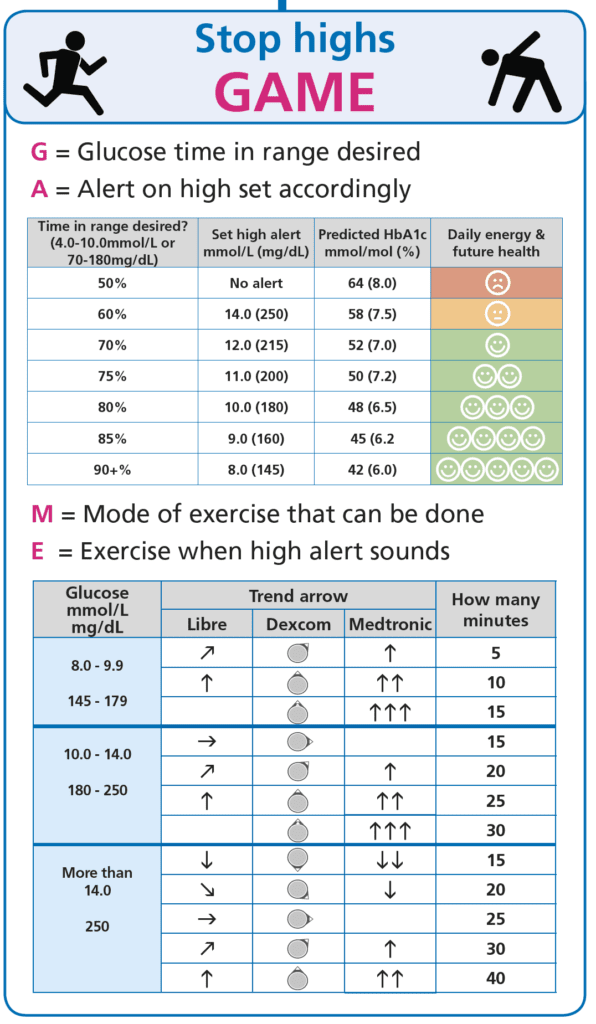
Tip 6: 50/50/20 – exercise adjustments for injections and standard pump therapy
- Strategy: Use a structured framework for insulin reductions around exercise when on MDI or standard pump therapy.
- Quote: “50/50/20… 50% insulin reductions for meals before (within 2 hours) and after, and 20% reductions of insulin overnight – or 20 g of carbs or 20 g protein.”
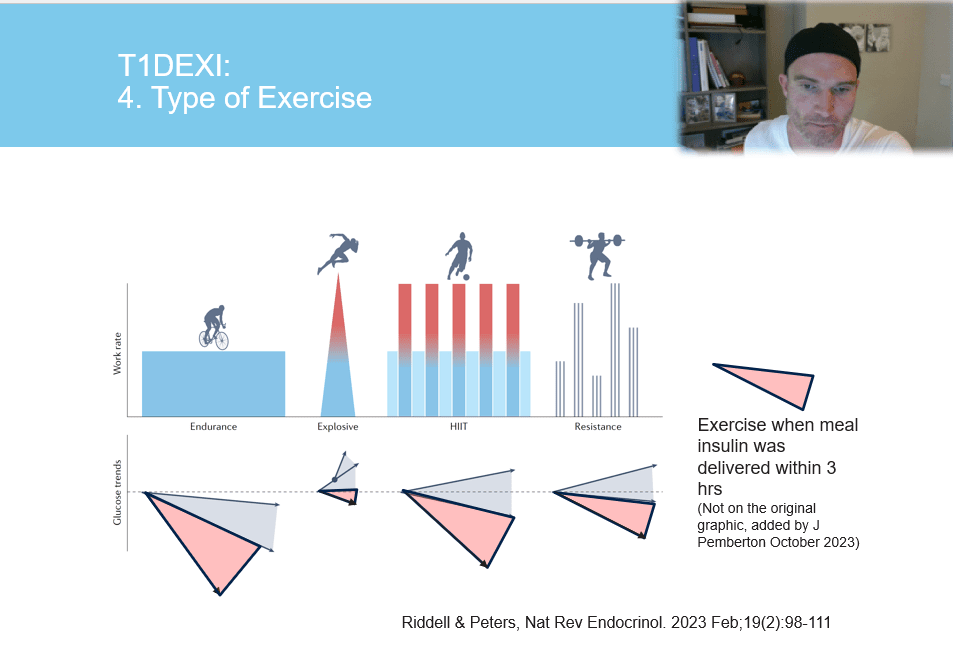
- Details: Exercise with rapid-acting insulin on board is a high-risk time for hypos. Planned dose reductions and snacks greatly reduce that risk.
- Extra tip: For many people, a bolus taken in the last 3 hours means there is likely still active insulin that can amplify the glucose-lowering effect of moderate activity – worth exploring carefully with your own CGM data and care team.
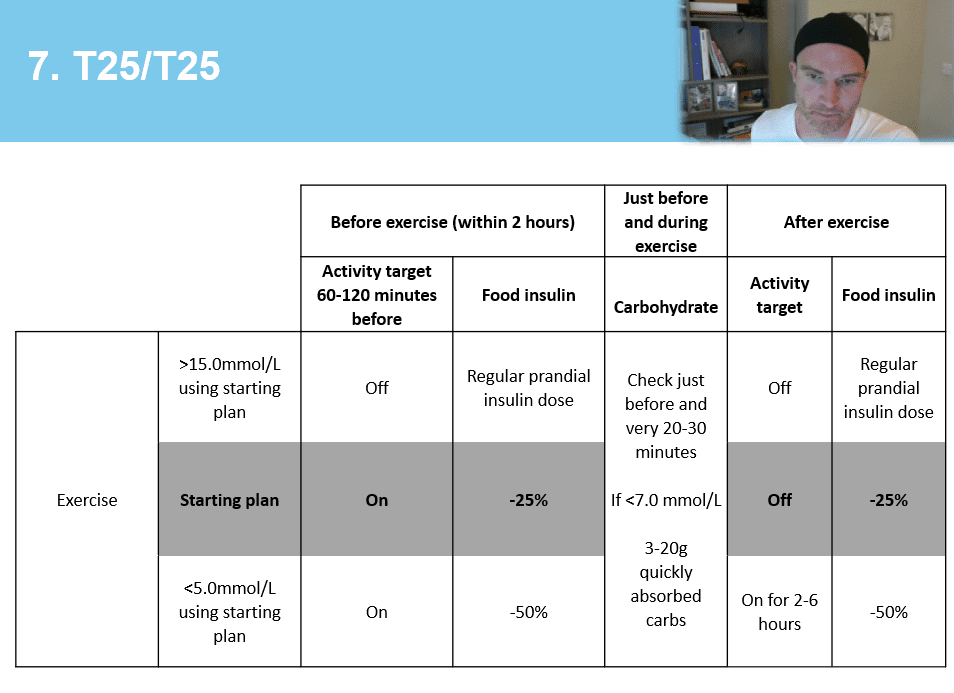
Tip 7: T25/T25 – exercise adjustments for AID therapy
- Strategy: For AID users, adjust insulin dosing and targets by 25% around exercise.
- Quote: “The first T25 is the two hours before exercise – aim for a 25% reduction for meals within two hours and start the exercise target 1 – 2 hours before. The second T25 is stopping the exercise target once you finish, and considering a 25% reduction for the meal after.”
- Details: Algorithms are powerful but not magic. They still need help around large changes like exercise.
- Extra tip: Trend arrows during exercise are one of the clearest signals available – and building a picture of your own response patterns over multiple sessions is far more informative than any average framework.
Tip 8: CGM management – SLO ARSE
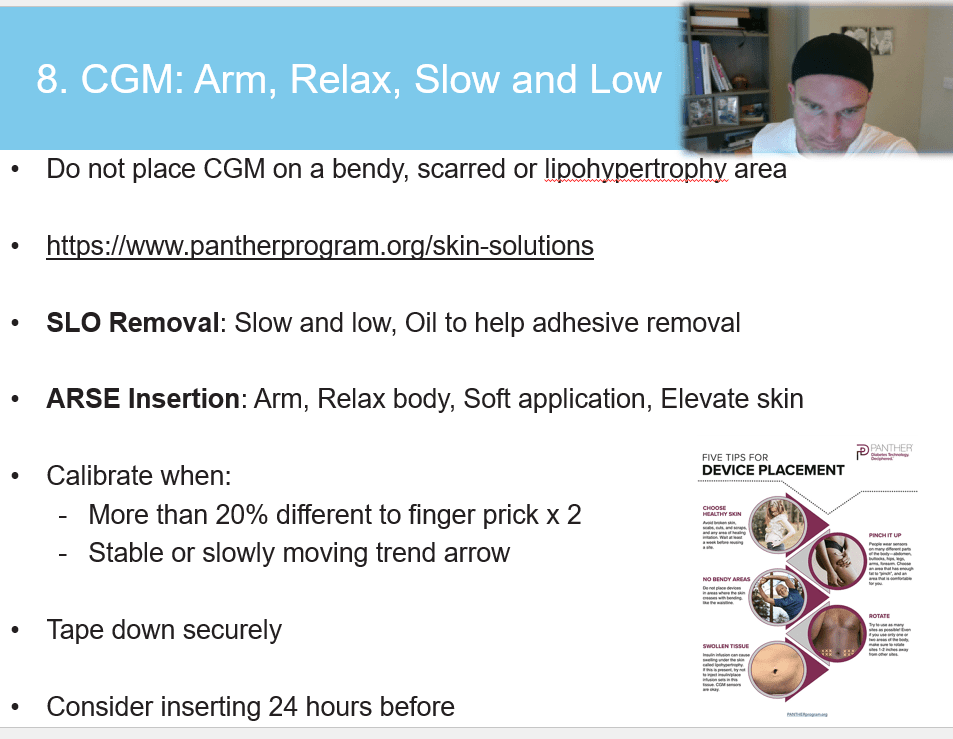
- Strategy: Use the SLO ARSE approach for better sensor sites and fewer failures.
- Quote: “Slow and low is the key… Relax your arm, make sure it is applied softly and elevate the skin off the muscle.”
- Details: Technique, skin prep, and site choice all affect accuracy and sensor life.
- Extra tip: Inserting the sensor a day before activating it is a technique some people find improves first-day accuracy – worth exploring if first-day readings seem inconsistent.
Tip 9: Site management
- Strategy: Rotate infusion, injection, and sensor sites to maintain good absorption and skin health.
- Quote: “Change every two to three days and look after your skin as you go along. Rotate where you do the sites.”
- Details: Lipohypertrophy and scar tissue can significantly blunt insulin absorption and distort CGM readings.
- Extra tip: A simple rotation map or chart can take the guesswork out of this over time.
Tip 10: Does your CGM change what your time in range means?
It depends on which zone your CGM system reads in.
CGM systems are calibrated against different reference methods, so the same physiological glucose can read differently depending on which sensor you wear. The A-P-B model describes the direction of that difference: Zone A reads above the physiological corridor, Zone P inside it, Zone B below it.
Only three sensors have been placed in a zone, and that placement rests on two independent head-to-head studies, neither designed, run nor analysed by a device manufacturer, reported across three papers (Eichenlaub 2025 with its companion metrics analysis Freckmann 2025, drawn from the same participants and the same data; plus Sanfilippo 2025, a separate study under structured exercise). A zone is earned by that exact sensor from published head-to-head data. It is never inherited from a device family, a manufacturer, or a shared reference method.
| Device | Manufacturer | Zone | Reference method |
|---|---|---|---|
| Dexcom G7 | Dexcom | Zone P, inside the corridor | Arterialised venous |
| FreeStyle Libre 3 Plus | Abbott | Zone P, inside the corridor | Venous |
| Medtronic Simplera | MiniMed (formerly Medtronic Diabetes) | Zone B, below the corridor | Venous |
The studies evaluated the sensor named FreeStyle Libre 3. John Pemberton reads the Libre 3 and the Libre 3 Plus as the same sensing and calibration architecture with a hardware revision, so he judges the Zone P finding to carry across to the Libre 3 Plus, the sensor Abbott currently ships. That is his clinical and technical judgement as lead author of the paper that defines these zones; it is not a separate published result, and the studies did not test the Plus. It is scoped to this sensor pair alone.
Reference method alone does not settle a zone. Medtronic Simplera is assessed against venous glucose, the same category as the Abbott sensors, and still reads in Zone B. That is why a zone has to be earned per sensor rather than inferred from how the sensor was assessed.
Every other CGM is not yet placed, including Dexcom G6, FreeStyle Libre 2 Plus, MiniMed Guardian 4, Roche SmartGuide, Dexcom Stelo and Eversense. Not placed means the head-to-head evidence needed to place it honestly has not been published, not that the device is a poor one.
What this means for a time in range figure. A Zone B sensor reports a higher time in range than a Zone P sensor for the same physiological glucose, in the region of 6 to 10 percentage points. The upper bound of 10 percentage points is from Pemberton 2026; the lower end is a GNL reading of the published range, not a separate published figure. The international 70% consensus target was derived from Zone P data, so the same percentage does not carry identical meaning across sensors. What that means for your own target is a conversation for you and your diabetes team.
In summary
Each tip here is a lever: some are behavioural (food, movement, exercise), some are technical (sites, sensors, meters), and some are about understanding how your CGM measures glucose in the first place. On average, implementing these strategies tends to improve time in range; how much any one of them matters for you personally is something only your own CGM data can tell you. Explore them with your diabetes care team.
This content is for educational exploration only. It describes average responses and general principles. It is not medical advice and cannot replace individual clinical guidance from your diabetes care team.
Evidence backbone
The two foundations at the top of this page – blood glucose testing as a backstop, and the calibration zone effect on time in range targets – both come directly from the GNL CGM Evidence Pack. The 10 tips themselves are practical applications of the wider GNL framework on dynamic glucose management, which is built on the same evidence base.
- Pemberton et al 2026 – International clinical opinion on CGM transparency, standardisation, and calibration alignment. The source of the A-P-B model that underpins Tip 10. Diabetes, Obesity and Metabolism. DOI: 10.1111/dom.70460
- Pemberton et al 2023 – The original CGM accuracy review behind the framework. Diabetes, Obesity and Metabolism. DOI: 10.1111/dom.14962
- Pleus et al 2026 – IFCC clinical assessment guideline. Clinica Chimica Acta. DOI: 10.1016/j.cca.2025.120728
- Moser & Pemberton 2024 – Editorial on AID safety and the exercise testing gap (Tips 5, 6, 7 all live here). Diabetic Medicine. DOI: 10.1111/dme.15305
- Pemberton et al 2025 – 20 minutes by 2 mmol/L: the activity snacking paradigm shift behind Tips 4 and 5. Original research.
Overall evidence grade: C (clinical opinion and consensus) plus B (Pemberton activity research). Confidence: HIGH.