
The GNL Podcast
Episode 34, Building High-Performance Type 1 Diabetes Care
A box of new technology arrives in a clinic, the device is handed over, and then nothing much happens for three months. The same kit, in another country, comes with a follow-up appointment booked before the person has left the room. Two clinics, the same hardware, very different lives. This episode is about why that gap exists and what closes it.
Ask Grace
Want to understand what time in tight range (70 to 140 mg/dL; 3.9 to 7.8 mmol/L) really asks of you, and where GLP-1 receptor agonists fit alongside insulin-only AID?
Listen
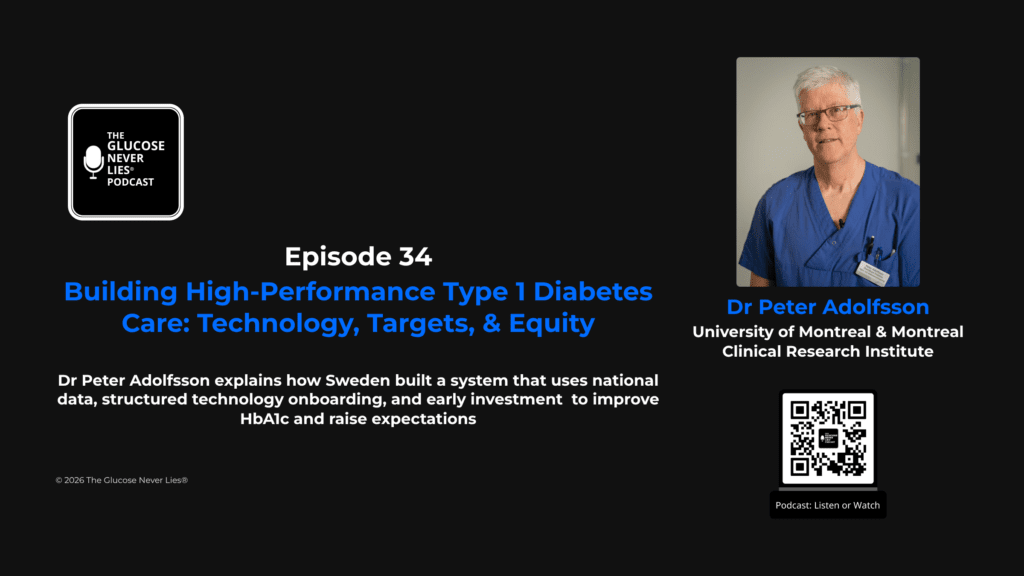
Also available on Buzzsprout and YouTube. Guest: Dr Peter Adolfsson (ISPAD 2022 Exercise Chapter Lead; Paediatric Diabetologist, Sweden). Host: John Pemberton. Director of Creativity: Anjanee Kohli.
Why this episode exists
If you live with type 1 diabetes, or you run a clinic that supports people who do, you already know that having access to CGM and automated insulin delivery (AID) is not the same as getting results from them. Many clinics now have the technology, yet outcomes vary widely between centres, regions, and countries. That gap is not just about the technology, it is about how teams educate, follow up, set targets, share best practice, and hold themselves accountable.
In this conversation, Dr Peter Adolfsson explains how Sweden built a system that uses national data, structured technology onboarding, and early investment, especially in the first two years after diagnosis, to improve HbA1c and raise expectations. The discussion also explores what comes after insulin-only AID: smarter data-driven care pathways and adjunct therapies such as GLP-1 receptor agonists.
In this episode
John and Peter trace a single thread: what it takes to turn “having technology” into “getting results from technology”, and why that work tends to be an investment rather than an optional extra. The conversation moves from the structure around device onboarding, through the role of national data and accountability, to where diabetes care may be heading next.
The discussion also explores what comes after insulin-only AID: smarter, data-driven care pathways and adjunct therapies such as GLP-1 receptor agonists. Throughout, the question Peter keeps returning to is how a service raises expectations for everyone, including the people who are too often left behind.
What this episode explores
- How Sweden used a national diabetes registry to create accountability and rapid learning between clinics
- Why early structured follow-up after starting CGM or AID tends to be an investment, not an optional extra
- How targets shape behaviour: changing what you measure changes what you achieve
- Why people with the highest HbA1c are often among those who benefit most from AID
- How to think about time in tight range (70 to 140 mg/dL; 3.9 to 7.8 mmol/L) in a way that is ambitious but humane
- Where diabetes “2.0” may be heading: smarter platforms, more frequent support, and mixed therapies including GLP-1 receptor agonists
Watch or listen
Key themes
Start technology with a structure, not a handout
Peter’s model: educate the person using the device, bring them back quickly (often within one to two weeks), then iterate with a clear target and a plan. Early follow-up is the part that tends to convert “having technology” into “getting results from technology”.
Invest up front, or do not start
If a clinic cannot support early and frequent follow-up after technology initiation, outcomes tend to plateau and frustration rises. The early investment phase is where the opportunity to improve is greatest.
Healthcare professionals need education too
Scaling outcomes requires training teams, not just families. Sweden has run large national pump and advanced technology courses, because a service cannot rely on a small number of enthusiasts to carry the knowledge burden for everyone.
Accountability drives improvement
Sweden’s national registry started with anonymised clinic comparisons, then moved to named clinic transparency. Once performance is visible and comparable, behaviour tends to change: clinics learn from the best-performing centres and compete to improve.
Aim high early, then individualise
In the first zero to two years after diagnosis, residual insulin can make tight targets more achievable, and early gains tend to pay off long-term. Later, targets still matter, but the burden and impact on daily life must be balanced so people do not burn out.
The high HbA1c group should not be left behind
Peter argues against the “prove yourself first” mindset. People who find bolusing, carb counting, or daily maths difficult are often among those who benefit most from AID, and withholding technology can deepen inequality.
Equity needs data, not good intentions
John reflects on discovering unequal AID onboarding by ethnicity despite believing the service was equitable. The fix started with measurement: check your onboarding, compare it to your population, then do the harder work to engage those who have been overlooked.
Care should follow need, not calendar appointments
With 288 CGM readings per day, one recurring question is why to wait three months to act. Peter describes a future where platforms flag deterioration early and clinics contact the right patients in the right week, while those doing well might attend less often.
Diabetes “2.0” may involve mixed therapy and smarter systems
Beyond insulin-only AID, Peter anticipates more personalised add-ons, including GLP-1 receptor agonists in selected cases, especially for those with high total daily doses and weight-related challenges. The goal is not only glycaemia but reducing insulin burden and supporting long-term health.
Aim high early, balance the burden later. In the first zero to two years after diagnosis, residual insulin can make tight targets more achievable and early gains tend to pay off long-term; later, targets still matter, but the burden and impact on daily life must be balanced so people do not burn out. The trade-off the episode names is between ambition and sustainability, held together rather than set against each other.
Practical exploration
For people living with type 1 diabetes and their families
The conversation has practical implications for anyone using CGM and AID, and the recurring theme is that early support and honest conversations matter more than waiting to “prove yourself”.
- Ask for early follow-up after starting a new device, small tweaks early can change everything
- Set targets that stretch you, but do not punish you: progress matters even when perfection is unrealistic
- If you are struggling with boluses or daily maths, say it out loud, that is a reason for more support, not a reason to delay technology
- If weight management is a major issue alongside high insulin doses, explore the full conversation with your team
For clinicians and educators
For clinics starting or scaling CGM and AID programmes, the episode is a reflection on how structure, data, and equity work together rather than a checklist to apply blindly.
- Build a standard onboarding pathway: education session, review at one to two weeks, then planned optimisation reviews
- Define what success looks like, range targets, hypoglycaemia thresholds, and what matters to the person
- Train the whole team, not just one or two enthusiasts: algorithms, settings logic, and common failure modes
- Use your service data: who is being offered technology, who is not, and why
- Prioritise those at highest risk: persistent high HbA1c, frequent admissions, or those overwhelmed by dosing complexity
- Measure outcomes, share learning, and copy what works from best-performing centres
About the guest
Dr Peter Adolfsson is a paediatric diabetologist in Sweden and a long-standing leader in technology-enabled type 1 diabetes care. He has contributed extensively to diabetes education, CGM use in clinical practice, and international guidelines, including leading the ISPAD 2022 Exercise chapter. His work focuses on turning devices into outcomes: structured onboarding, early follow-up, clear targets, and systems that support both clinicians and families.
Related reading on GNL
Episode 34 of the GNL Podcast
Building high-performance type 1 diabetes care
This content is for educational exploration only. It describes average responses and general principles. It is not medical advice and cannot replace individual clinical guidance from your diabetes care team.